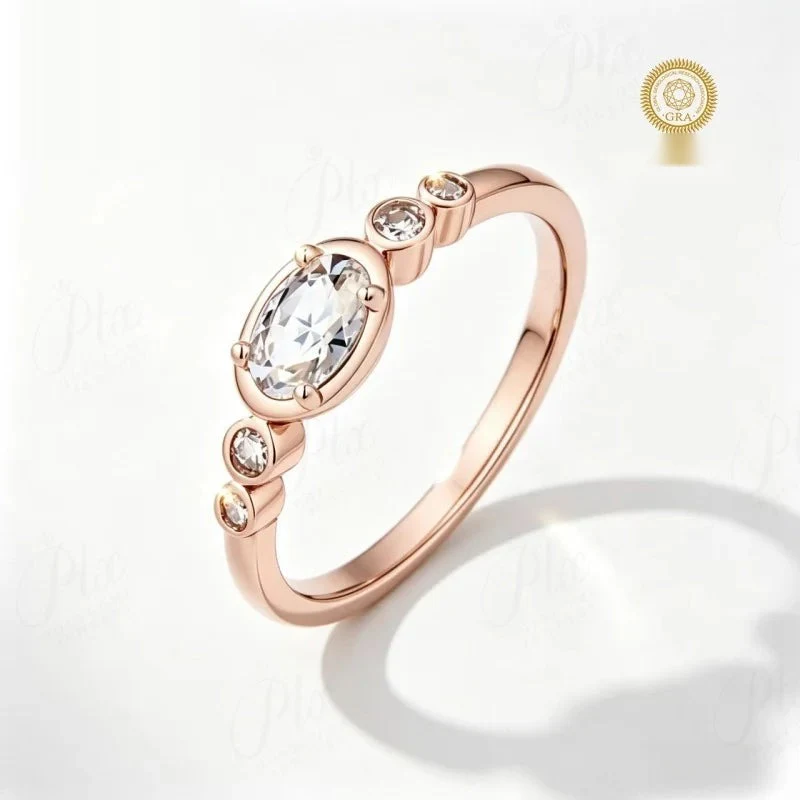
A boutique jeweler in Austin received a client who walked in with a torn photo of a 1920s solitaire, a request for a 7.5 mm moissanite center, and a three-week deadline. That kind of brief is exactly what a custom moissanite ring workflow is built for. The difference between a finished ring the client cries over and a remake that eats two weeks is how the steps between the sketch and the cast are handled. Below is the seven-step process our workshop runs on every custom engagement and wedding order, with the time each stage actually takes.
We break production into intake, design confirmation, modeling, casting, setting, finishing and QC. Most of the questions buyers ask us about lead time come down to which stage is on the critical path, so knowing the sequence helps you set honest expectations with your own retail customers.
Step 1: Intake and stone lock (day 1 to 2)
The first call is about facts, not feelings. We record the center-stone size in millimeters, the desired metal (925 sterling, 10K, 14K or 18K gold, or 950 platinum), the band width, the finger size, and the budget. Moissanite is sold by millimeter rather than by carat, so a 6.5 mm stone is roughly a 1.0 carat equivalent and an 8.0 mm stone is about 2.0 carats; the exact equivalence depends on the cut. We also lock the stone at this stage because a wrong millimeter dimension is the single most common cause of a head that will not fit. For the optical basics we reference GIA's 4Cs framework, even though moissanite is not a diamond.
Step 2: Sketch and quote (day 2 to 4)
An artisan hand-sketch front and profile views on paper. This is not decorative: the profile view shows the cathedral height, the shoulder angle and how far the stone sits off the finger. The quote is attached to the sketch and itemizes the metal weight, the stone, the labor, and any engraving or pavé extras. A typical solitaire quote breaks down to roughly 45% metal and labor, 35% center stone, and 20% setting and finishing.
Step 3: CAD model and render (day 4 to 8)
Once the sketch is approved, a CAD designer rebuilds it in 3D. You receive two or three rendered images from different angles plus a measured cross-section. This is the cheapest point at which to change anything. The sketch-to-CAD workflow write-up covers the geometry decisions in detail. Most clients request one or two revisions here; we cap revisions at three free rounds to keep the schedule intact.
Step 4: Printing, casting and casting clean-up (day 8 to 14)
The CAD file goes to a resin printer, the wax is invested and burned out, and the metal is cast. After casting, a caster removes sprues, resurfaces the sprue points, and checks that the ring finger size is within +/- 0.3 mm of target. Casting shrinkage is baked into the CAD scale at about 1.5 to 2% depending on the alloy.
Step 5: Stone setting and hand finishing (day 14 to 19)
The setter seats the moissanite, seats any side stones, and the polisher moves through 400-, 600- and 1200-grit compounds before the final high polish. Prong tips are shaped and rounded so they do not catch hair. The choice between prong and bezel settings is made at this stage and affects how long setting takes.
Step 6: Quality control and plating (day 19 to 21)
QC measures the head, checks prong tightness with a point, tests the engraving legibility, and verifies the ring size on a mandrel. Rhodium plating for white-metal pieces happens last, after polish. Our full pre-shipment QC checklist lists the 14 checks we run.
Step 7: Photography and shipment (day 21 to 23)
We shoot the finished piece on a neutral grey card, email the photos for sign-off, and ship insured. Total door-to-door for a single custom solitaire is 21 to 25 working days; pavé and halo designs add 4 to 6 days.
How long does a custom moissanite ring take?
A single-stone solitaire runs 21 to 25 working days. Halo, pavé or three-stone designs run 28 to 35 days. Rush production at a 30% surcharge can compress a solitaire to 12 to 15 days.
What information do you need from my client to start?
The center-stone millimeter size, metal choice, band width, finger size, reference photo or sketch, and the budget range. Without the millimeter size we cannot lock the head.
Can I supply my own moissanite stone?
Yes. We accept consigned stones and set them on a verified-girth basis; we measure every stone on arrival against the certificate and document it before the head is cut.
How many CAD revisions are included?
Three revision rounds are included in the quote. Further changes after the third round are billed at $45 per revision and add one working day each.
Do you produce custom rings at small wholesale runs?
Yes. MOQ for a one-off custom piece is 1 unit; for a repeatable design produced in batches the minimum is 5 units per size bracket. See our small-batch MOQ and timing guide for the batch economics.
Send us your client's sketch, millimeter size and metal choice. We will return a CAD render and a firm quote within three working days, and we ship the finished piece insured worldwide. Start your custom order today.
Frequently Asked Questions
Is moissanite a good diamond alternative for retail buyers?
Yes for price-sensitive customers who want brilliance and hardness. Moissanite ranks 9.25 on the Mohs scale, holds up to daily wear and costs a fraction of a natural diamond of the same size, so it resells fast in bridal and fashion lines.
What is the minimum order for wholesale moissanite?
MOQ starts at 50 pieces per design for stock items. Custom cuts and private-label settings usually start at 100–300 pieces depending on the mold.
Do you provide certificates with moissanite stones?
Yes. Every parcel ships with GRA or IGI documentation listing carat weight, color grade and cut. We recommend passing the certificate to your end customer for trust.
How long does sample and bulk production take?
Samples ship in 3–5 days. Bulk runs take 15–20 days under 500 pieces, and 25–30 days for custom work.