A jeweler in Manchester emailed us a hand-drawn cross-section: a low-profile cathedral solitaire, a tapered band, and a hidden halo she wanted visible from the side. The sketch was charming but ambiguous, and ambiguity in a sketch is how heads end up 0.4 mm too small. Turning that sketch into a production-ready CAD model is a translation job: every pencil line becomes a measured surface, and every ambiguous angle becomes a decision we flag back to the buyer. This article walks through the six translation steps our CAD team runs on every custom order.
Why a sketch is not a spec
A sketch communicates intent. It does not communicate measurements. A 10 mm band drawn by hand is the same width on paper as a 2 mm band; the eye does not scale. CAD exists to impose a millimetric scale on the intent. The optical properties of moissanite also matter here: because moissanite has a higher refractive index than diamond, a shallow crown that looks fine on paper can leak light from the side, so the CAD model is where we enforce table, crown angle and depth targets.
Step 1: Measuring the reference stone
Before any geometry is drawn, the chosen moissanite is measured on a Presidium gauge to +/- 0.01 mm. The head pocket in CAD is cut to the measured width, length and girdle thickness, not to the nominal catalog size. This one habit eliminates roughly 80% of the head-fit problems we used to see on first samples.
Step 2: Blocking out the ring in Orthographic view
The modeler draws three flat views first: front, side, top. The finger size, band width at the shoulder, band width at the base, and cathedral height are entered as parameters. Parameters matter: changing the finger size later should re-drive the whole ring, not require a rebuild.
Step 3: Lofting the shank and shoulders
The flat views are lofted into a 3D solid. The shoulder transition, where the straight band meets the head, is the place most amateur models fail: too sharp and the ring will cast with a hot spot; too soft and the design looks mushy. We keep a minimum wall thickness of 1.2 mm on the shank for comfort-fit bands.
Step 4: Cutting the head and seat
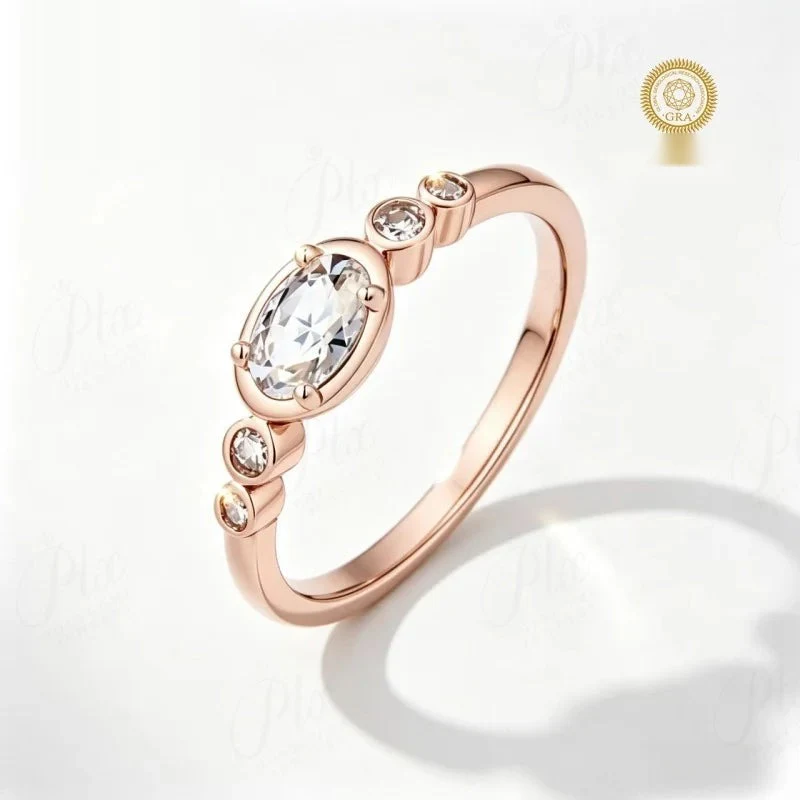
The seat is cut to the measured stone girth. Prong positions are laid out: six prongs for stones above 7 mm, four for stones below. The prong shoulder angle is set at roughly 45 degrees to the girdle so the prong lifts the stone slightly off the seat and lets light enter through the pavilion. If the client wants a bezel rather than prongs, this is where the wall thickness is set to 0.8 to 1.0 mm.
Step 5: Rendering and engineering review
The model is rendered in a neutral environment from four angles and sent to the buyer. In parallel, an engineer checks for undercuts that would block burnout, walls thinner than 0.6 mm, and prong tips too short to tension-set. Anything flagged goes back into the model before print.
Step 6: Export to STL and print prep
The final STL is checked for non-manifold edges, scaled by the alloy shrinkage factor (1.8% for 14K gold, 2.2% for sterling), and oriented on the printer supports. A resin print weighs about 2 grams; the cast piece will weigh the target metal weight. We also run a wall-thickness audit on the exported mesh: any continuous wall under 0.6 mm is thickened before print, because thin walls are the second most common cause of casting porosity after burnout temperature.
How long does sketch-to-CAD take?
First CAD render for a solitaire is typically 2 to 3 working days after intake. Halo and pavé designs take 4 to 5 days because each accent stone is placed individually.
Can I see the model before it is cast?
Yes. We send rendered images, and on request we can export a 3D PDF or a turntable video so the buyer can rotate the design on a phone.
What if my sketch is not to scale?
That is normal. We scale the sketch to the measured stone and confirm the proportions with you in writing before modeling. We flag any proportion that will not read at real size.
Do you keep the CAD file for reorders?
Yes. Approved designs are archived against your buyer account, so a reorder in a different finger size is a parameter change and costs a fraction of the first-order modeling fee.
Can CAD handle engraved details from day one?
Text engraving is added at the CAD stage as an emboss or recessed channel; deep hand engraving is done after cast. See our inside-band engraving options article for the depth and font limits.
Send us your pencil sketch, the measured stone, and the finger size. We will return a rendered CAD model and a firm casting quote within three working days. This CAD step sits at the front of our full seven-step custom ring workflow, so once the model is approved the rest of the schedule is already locked. Request your CAD render now.
Frequently Asked Questions
Is moissanite a good diamond alternative for retail buyers?
Yes for price-sensitive customers who want brilliance and hardness. Moissanite ranks 9.25 on the Mohs scale, holds up to daily wear and costs a fraction of a natural diamond of the same size, so it resells fast in bridal and fashion lines.
What is the minimum order for wholesale moissanite?
MOQ starts at 50 pieces per design for stock items. Custom cuts and private-label settings usually start at 100–300 pieces depending on the mold.
Do you provide certificates with moissanite stones?
Yes. Every parcel ships with GRA or IGI documentation listing carat weight, color grade and cut. We recommend passing the certificate to your end customer for trust.
How long does sample and bulk production take?
Samples ship in 3–5 days. Bulk runs take 15–20 days under 500 pieces, and 25–30 days for custom work.