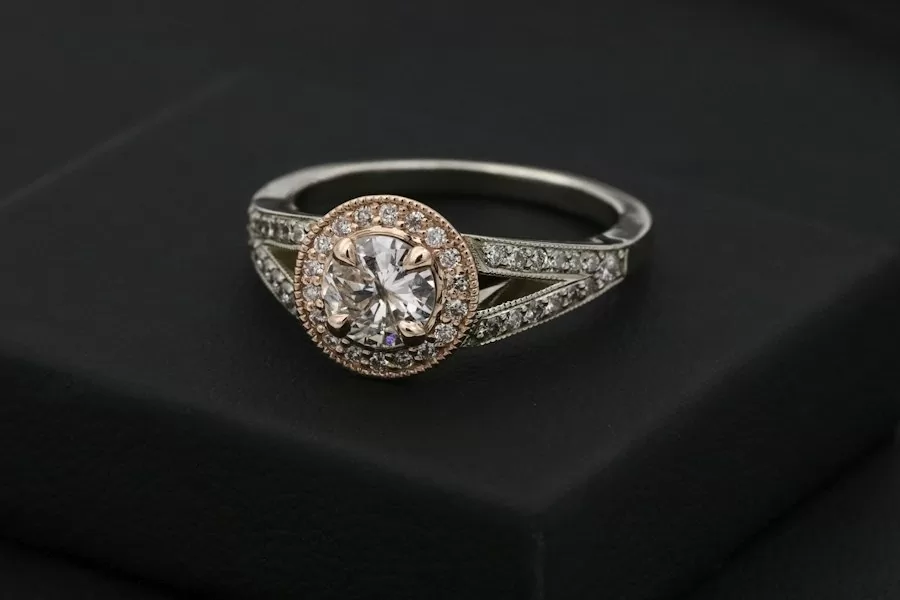
Of all the engagement ring settings, the three-stone or "trilogy" ring carries one of the most romantic stories. The three stones traditionally represent the couple's past, present, and future together. It is a meaning that photographers, proposal planners, and jewelers love to explain, and it gives the ring a narrative a solitaire simply does not have. Today, moissanite has made the trilogy setting far more accessible. Three well-cut stones in solid sterling silver cost a fraction of what three comparable diamonds would, which means couples can choose a setting they love without stretching the budget to breaking point.
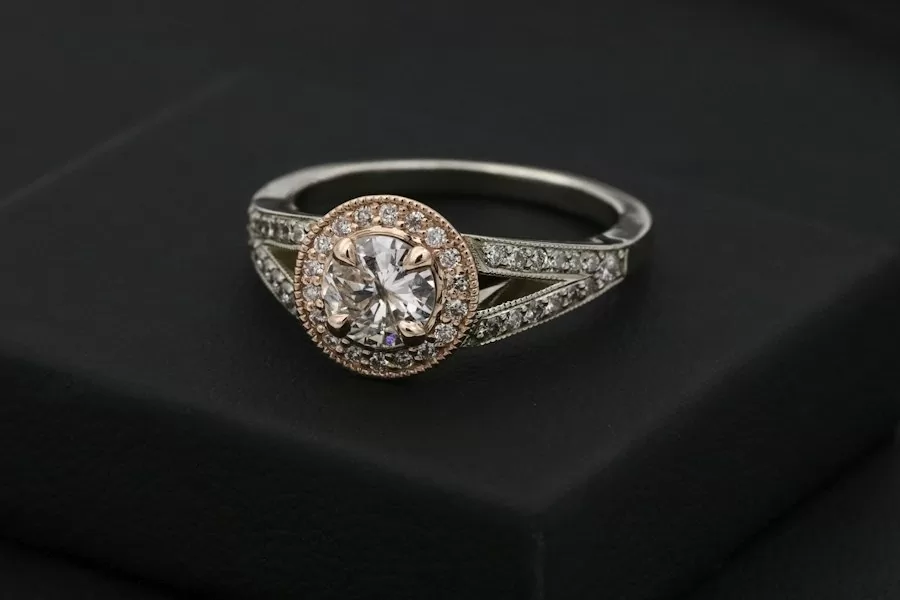
The classic trilogy uses a larger center stone flanked by two smaller side stones. That center stone is the focal point, so most couples choose a shape that suits their partner's taste. Round brilliant, oval, and cushion cuts are the most popular for three-stone rings because the faceting reads beautifully from a distance. Moissanite's characteristic fire and brilliance actually suits this setting well: the side stones catch the light at angles a single stone never can. If you are still deciding on a cut, our guide to moissanite cuts and shapes walks through how each cut wears on the hand.
Choosing the metal is next. Sterling silver offers a bright, cool backdrop that makes colorless moissanite pop, and it keeps the ring approachable for a proposal on a budget. Many couples choose rhodium-plated sterling silver for a whiter, diamond-like finish that resists tarnish. If you want a refresher on that finish, our note on rhodium plating on silver explains what it adds and how to care for it. For a warmer look, a two-tone version with gold-toned accents can soften the design, but the traditional trilogy shines best in a clean white metal.
Think about proportions. The side stones should complement, not compete with, the center. A center stone that feels oversized next to tiny accents can look unbalanced. Most designs aim for side stones around a third to half the width of the center stone. Band width matters too: a slimmer band reads delicate and modern, while a slightly wider band feels substantial and vintage. Our guide to band width and finger proportions helps you match the ring to the wearer's hand rather than the trend of the moment.
The meaning behind the ring is worth getting right in your proposal moment. The "past, present, future" reading is the classic, but couples adapt it freely: friendship, love, and family; mind, body, and spirit; or three important milestones. When you present the ring, say the meaning out loud. That small gesture turns a piece of jewelry into a story your partner will retell for years. If you are putting together a full set, our guide to moissanite eternity bands pairs beautifully with a trilogy as a wedding band.
You also have freedom in how the stones are shaped. A popular modern twist mixes shapes: a round center stone flanked by two pear-shaped or marquise side stones, for example. That variation adds character and makes the ring feel less like a catalog design and more like a collaboration between you and the jeweler. Moissanite takes these mixed shapes well, because every cut carries the same brightness. If you prefer symmetry, two matching side stones keep the classic, balanced look that photographs beautifully. There is no wrong choice, only the one that suits your partner's taste.
Think about how the ring will pair with a wedding band. A trilogy with a low, smooth profile tucks neatly against a plain band, while a setting that sits high can make a wedding band feel tight. If you plan to wear both rings eventually, ask about a contoured or curved wedding band that nestles against the engagement ring. That small detail keeps the two pieces comfortable together for decades. Many couples choose the trilogy now and add the eternity-style band at a later milestone, which keeps the story growing.
Budget realistically. A three-stone ring in moissanite and sterling silver gives you the look of a multi-stone diamond design at a price that leaves room for the proposal itself, the photographer, and a honeymoon. Many couples use the savings to invest in a better-cut center stone rather than spreading budget thin. If you are working within a tight figure, our guide to moissanite engagement rings on a budget covers where to spend and where to save.
Care for the ring as you would any heirloom. The side stones sit in settings that can catch on fabrics, so remove the ring during heavy work or cleaning. A quick polish with a soft cloth keeps the silver bright. With sensible wear, a trilogy ring is not just an engagement piece. It is the ring that tells your story, and its three stones will keep reminding both of you what the years together are for.
The Wikipedia article on rhodium explains why rhodium plating is applied to white gold and silver jewellery.
Frequently Asked Questions
Is moissanite a good diamond alternative for retail buyers?
Yes for price-sensitive customers who want brilliance and hardness. Moissanite ranks 9.25 on the Mohs scale, holds up to daily wear and costs a fraction of a natural diamond of the same size, so it resells fast in bridal and fashion lines.
What is the minimum order for wholesale moissanite?
MOQ starts at 50 pieces per design for stock items. Custom cuts and private-label settings usually start at 100–300 pieces depending on the mold.
Do you provide certificates with moissanite stones?
Yes. Every parcel ships with GRA or IGI documentation listing carat weight, color grade and cut. We recommend passing the certificate to your end customer for trust.
How long does sample and bulk production take?
Samples ship in 3–5 days. Bulk runs take 15–20 days under 500 pieces, and 25–30 days for custom work.