A jewellery buyer in Manchester sent us a CAD revision request after the customer returned a solitaire: the stone sat too high, the prongs caught on knitwear, and one prong bent inward within six weeks. The centre stone was fine. The prong choice was the problem. Four slim 0.9 mm cathedral prongs on a 6.5 mm round moissanite read elegant on a render and read fragile on a hand.
Prong style is not a cosmetic toggle in our order form. It sets seat depth, head height, prong wall thickness and how often the ring comes back for retipping. Below are the six prong configurations we build on custom moissanite rings, with the wire gauge and wear notes we quote to buyers up front.
Four-prong solitaire: maximum light, minimum coverage
Four-prong heads are the default for buyers who want maximum face-up light. We build them in 1.0 mm round wire on stones up to 7 mm, stepping to 1.15 mm wire above that. The trade-off is coverage: four points hold the girdle at 12, 3, 6 and 9, so more of the crown is exposed. That is flattering for a round or cushion, but on a 9 mm pear or oval the exposed tips catch on gloves and handbags. We pair four-prong heads with a low seat (1.6 mm off the finger) for daily-wear engagement rings.
Our prong versus bezel write-up covers the coverage argument in depth; this piece stays on prong geometry.
Six-prong tulip: the durability upgrade
Six-prong tulip heads spread the girdle contact across six points instead of four, which drops per-prong stress by roughly a third. We spec tulip prongs in 0.85 mm wire on a 6.5 mm stone. Each tip is bent over the crown at 30 degrees and burnished shut, so the stone is pinned rather than cradled. The tulip shape narrows the wire at the shoulder and rounds it over the tip, which keeps the setting looking open while adding a sixth point of contact. Buyers selling to nurses, chefs and gym members should default to six prongs.
Crowning and v-tip prongs for fancy shapes
Oval, pear and marquise moissanite need protected corners. We use v-tip (claw) prongs at the four pointed ends and round prongs on the curved shoulders. A v-tip prong cups the point of the stone instead of sitting on it, which prevents chipping at the girdle tip. Seat depth on a v-tip head runs 0.4 mm deeper than a round-prong head, so buyers must tell us the stone's culet height before we model the seat. We reference GIA's cut vocabulary when describing crown and girdle geometry; moissanite is not a GIA-graded diamond, but the measurement language transfers.
Basket, euro and shared-prong heads
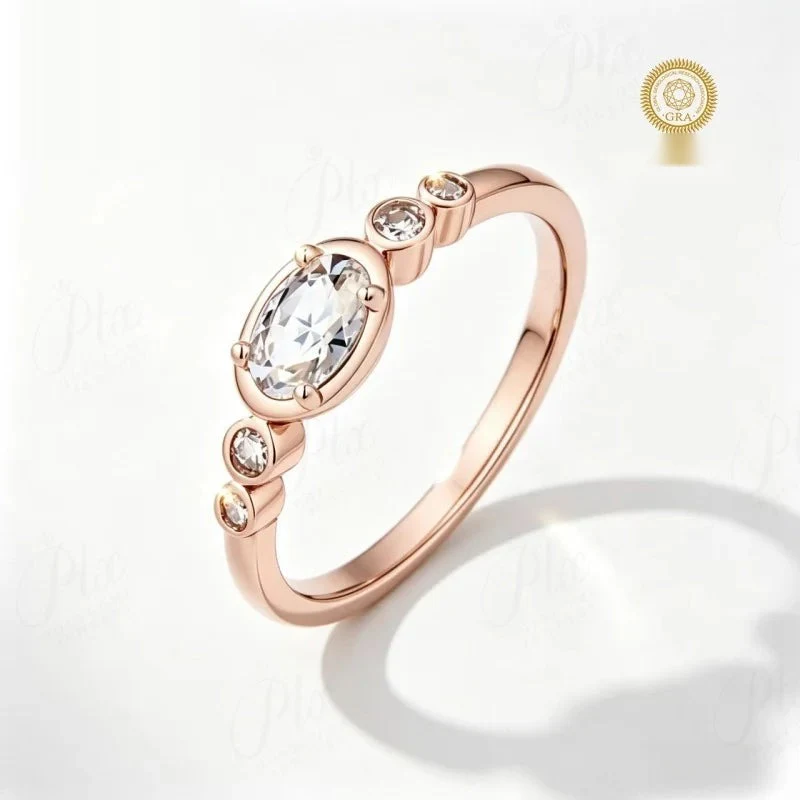
A basket head adds a lower wire rail under the girdle for vertical support; we use it on thin bands under 1.6 mm where the head wants extra bracing. Euro (rounded) prongs are the same wire but with the tip filed into a soft dome so the setting does not catch on fabric. Shared-prong heads are our pavle economy option: one prong holds two adjacent melee, which lowers labour cost by about 12 percent on a three-stone or halo ring. Shared prongs are not suitable for the centre stone on a solitaire.
Retipping and prong wall minimums
We hold a 0.35 mm prong wall minimum at the tip on a 6.5 mm centre. Below that, the prong wears through in about 18 to 24 months of daily wear and the stone risks shifting. A retipping service after delivery runs USD 8 per prong and requires the stone to be lifted; we flag this on the proforma so buyers price the service into their aftercare plan. Our resizing and after-sales guide lists the same retipping lead time, and our ring design process overview shows how prong wall thickness is modelled in CAD.
How do I choose between four prongs and six prongs?
Six prongs if the ring is worn daily by an active client; four prongs if the priority is maximum face-up brilliance and the ring is occasional wear. We quote six prongs as standard on stones above 8 mm regardless.
Do v-tip prongs reduce brilliance on a pear stone?
Minimally. The v-tip covers the pointed ends where light return is already low, so the centre crown reads the same. Buyers notice the durability gain far more than the tiny coverage at the corners.
Can I mix round and v-tip prongs on one head?
Yes, and we do it on every oval, pear and marquise head. The pointed ends get v-tips; the curved shoulders get round prongs. This is a spec value we confirm on the signed intake sheet, not a CAD surprise.
What prong wire gauge do you use on a 10 mm stone?
1.35 mm round wire minimum, six prongs, with a basket rail. A 10 mm moissanite in four slim prongs will return for retipping within a year; we will not release that file to production.
Send us the stone shape, carat and the client's daily-wear profile. We return a recommended prong config, wire gauge and head height on the signed spec sheet before CAD opens. Ask us to spec your next custom moissanite ring prong layout.
Frequently Asked Questions
Is moissanite a good diamond alternative for retail buyers?
Yes for price-sensitive customers who want brilliance and hardness. Moissanite ranks 9.25 on the Mohs scale, holds up to daily wear and costs a fraction of a natural diamond of the same size, so it resells fast in bridal and fashion lines.
What is the minimum order for wholesale moissanite?
MOQ starts at 50 pieces per design for stock items. Custom cuts and private-label settings usually start at 100–300 pieces depending on the mold.
Do you provide certificates with moissanite stones?
Yes. Every parcel ships with GRA or IGI documentation listing carat weight, color grade and cut. We recommend passing the certificate to your end customer for trust.
How long does sample and bulk production take?
Samples ship in 3–5 days. Bulk runs take 15–20 days under 500 pieces, and 25–30 days for custom work.