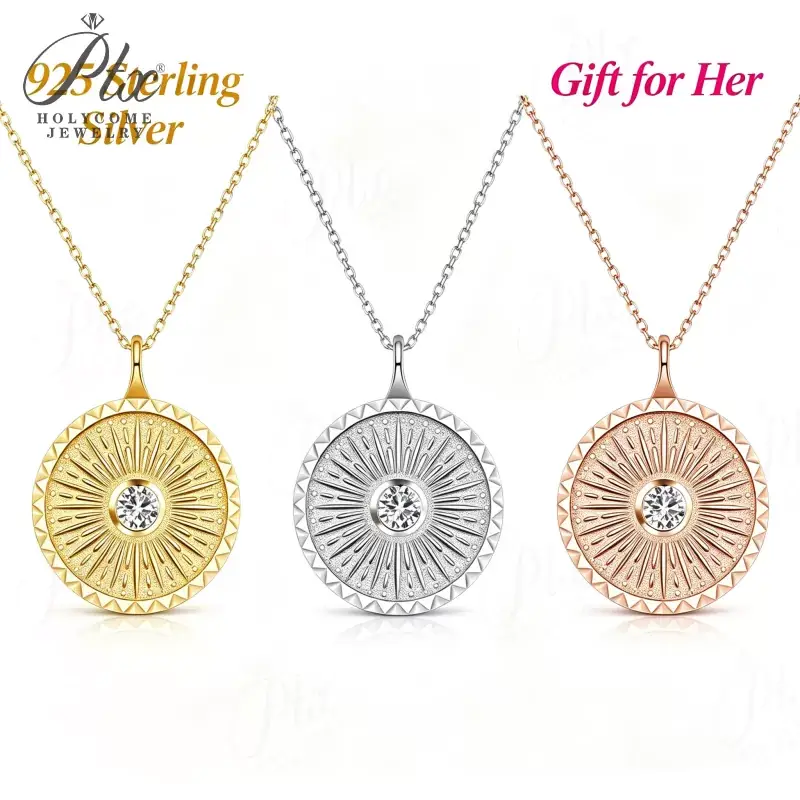
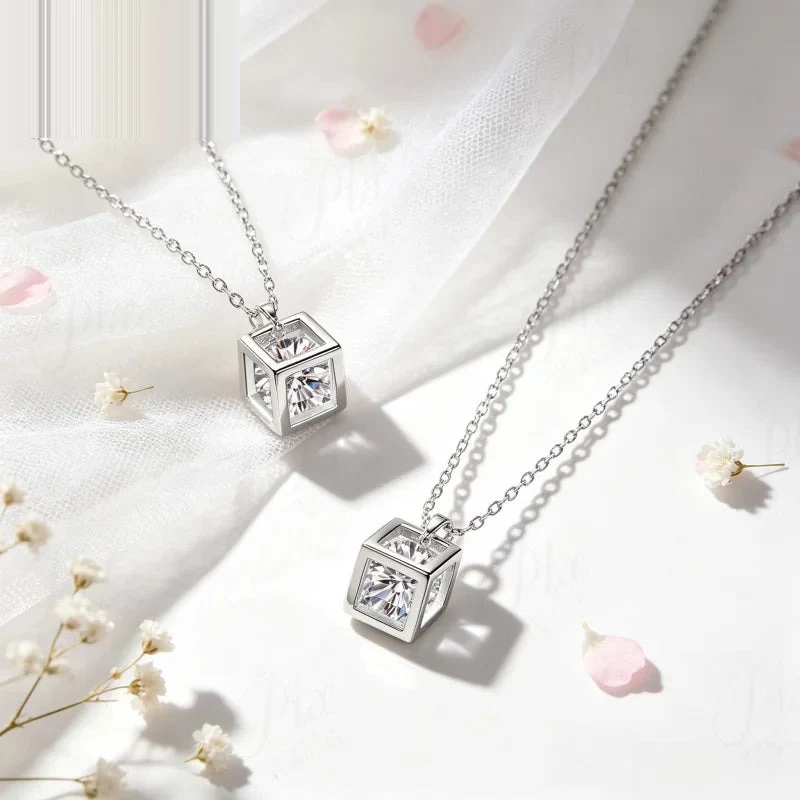
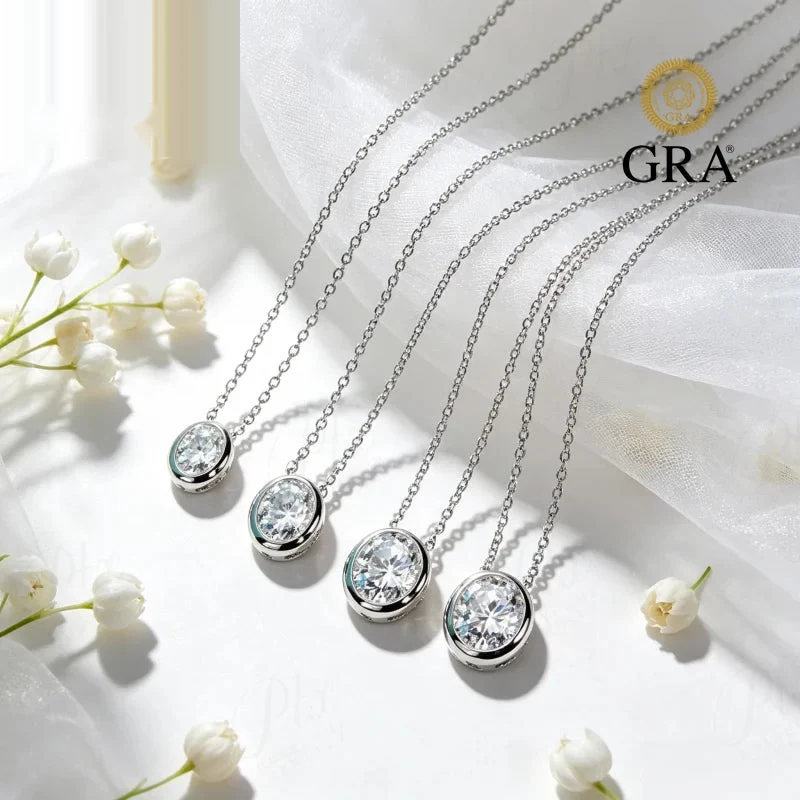
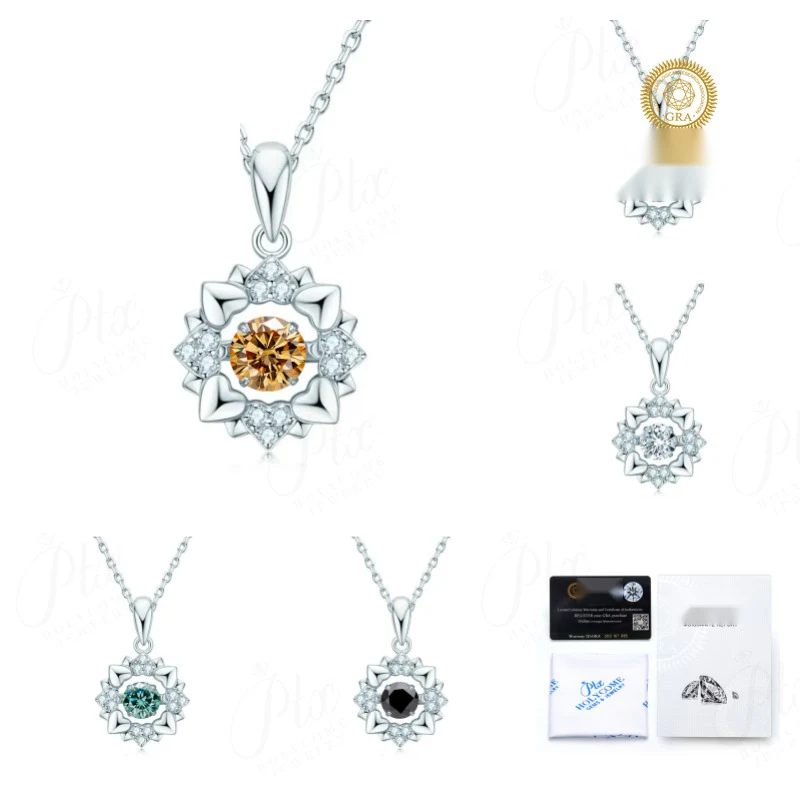
A jewelry buyer in Stockholm asked us to design a 9x7 mm oval moissanite pendant that would sit flat against the collarbone. The pendant itself was easy. The three decisions that made the order work were the chain gauge, the bail interior width, and the drop length. A pendant that looks perfect in CAD can still look wrong on a neck if those three numbers are off. This article is the reference we send to buyers before they commission a custom moissanite pendant.
Stone size and the face-up budget
Pendants are the one category where buyers consistently oversize. A 9x7 mm oval (about 2.0 ct equivalent) reads elegant on a 45 cm chain; a 10x8 mm starts to look heavy. The commercial sweet spot for a solitaire pendant is 7x5 mm to 9x7 mm ovals, or 6.5 to 8.0 mm rounds. Anything above 10x8 mm needs a reinforced bail and a 1.5 mm-plus chain. The dispersion of moissanite means the pendant flashes in indirect indoor light, which is what buyers are usually paying for; a stone that is too large over-flashes and looks cheap under office lighting. For the face-up trade-offs between oval, pear and round at these sizes, see our shape selection guide.
Chain length and gauge
The three chain lengths we stock as standard are 40 cm (choker), 45 cm (princess) and 50 cm (matinee). The 45 cm length is the default because it lands at the collarbone, which is where a pendant draws the eye. Chain gauge scales with the stone: a 6.5 mm pendant pairs with a 0.8 to 1.0 mm cable chain; a 9x7 mm pendant pairs with a 1.2 to 1.5 mm cable or cable-twist; anything above 10 mm needs a 1.8 mm chain for safety. Sterling silver chains weigh about 0.8 grams per 45 cm at 1.0 mm; 14K gold chains weigh roughly 1.5 grams at the same gauge.
The bail: the most over-engineered or under-engineered part
The bail interior width must clear the chain by 0.2 mm on each side so the pendant flips freely. A 1.2 mm chain needs a bail interior of at least 1.6 mm. We also keep the wall of the bail at 0.6 mm minimum, because a thin bail is the number-one point of failure on a returned pendant. For stones above 8 mm we switch to a double bail, which distributes the load across two solder joints rather than one. If the client wants the pendant to sit facing forward rather than flipping, we use a fixed bail soldered at a 15-degree angle.
Drop length and proportion
The drop is the vertical distance from the top of the bail to the bottom of the stone. A pendant with a drop under 12 mm reads as a stud on a chain; above 25 mm it reads as a statement. The most popular custom drop is 16 to 20 mm on a 7x5 to 8x6 mm oval. We also match the drop ratio to the stone: a pear pendant hangs longest and slimmest; a round pendant hangs shortest. Buyers commissioning matching couple pendants usually ask for asymmetrical drops, one longer for her and one shorter for him.
Backings and security
For pendants above 2 grams we ship a figure-8 safety catch rather than a spring ring, because spring rings open under repeated catching. We also recommend a silicone clutch on the chain end opposite the pendant so the pendant can be worn centered. These are small costs but they are the difference between a pendant that stays on the neck and one that comes back for repair.
What chain length should I stock?
45 cm is the highest turnover and should make up 60% of your chain stock. Stock 40 cm and 50 cm at 20% each. We ship chains separately so you can swap lengths without re-casting the bail.
Can I supply my own chain?
Yes. We measure the chain wire diameter on arrival and machine the bail to fit. A bail that does not match the chain diameter will either bind or flip loosely.
How heavy is too heavy for daily wear?
Above 5 grams total pendant weight, most customers notice the pull on the neck. We flag any design that tips past 5 grams and offer a smaller stone or an open-back setting to cut weight.
Do you make matching pendant and earring sets?
Yes. We use the same stone cut for the pendant and the earring pair, which lets buyers sell a set rather than a single piece and raises average order value.
How long does a custom pendant take?
21 to 28 working days from CAD approval, plus 2 to 3 days for the chain if we source it to order. Rush is available at a 30% surcharge.
Send us the stone size, chain length and bail preference. We will return a CAD render and a chain recommendation within three working days. Request your pendant quote.
Frequently Asked Questions
Which chain lengths should I stock first?
16 to 18 inch covers most necklines and gift purchases. Add 20 inch for layering sets and 24 inch for pendant lines.
Are your chains nickel-free and hypoallergenic?
Yes. Sterling silver is 92.5% silver; stainless lines use 316L. Both are nickel-safe for reactive customers when plated correctly.
Can necklaces be personalized?
Laser engraving on pendants and clasps is available from 50 pieces, with 3–5 day turnaround on the engraving step.
What is the bulk lead time?
15–20 days under 500 pieces; 25–30 days for custom pendants or new molds.