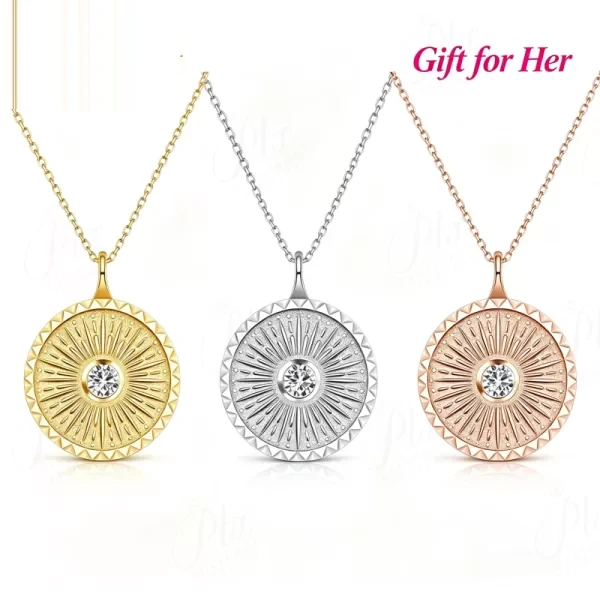
A small boutique in Portland told us that about one in three moissanite pendants came back with the same complaint: the stone face-down on the chest, spinning on the chain. The pendant itself was set correctly. The problem was that the chain and the bail had been picked separately, and the bail was too narrow to sit flat on the link gauge we shipped. That kind of return is the reason we treat the chain, the bail and the drop length as one decision on every custom moissanite necklace.
The pendant head is the easy part. The necklace is really two engineering problems: the chain must carry the weight without stretching, and the bail must sit so the stone faces forward. Below are the numbers we quote buyers so they can promise their clients the pendant will sit the way it did in the render.
Why chain gauge and bail width are a paired decision
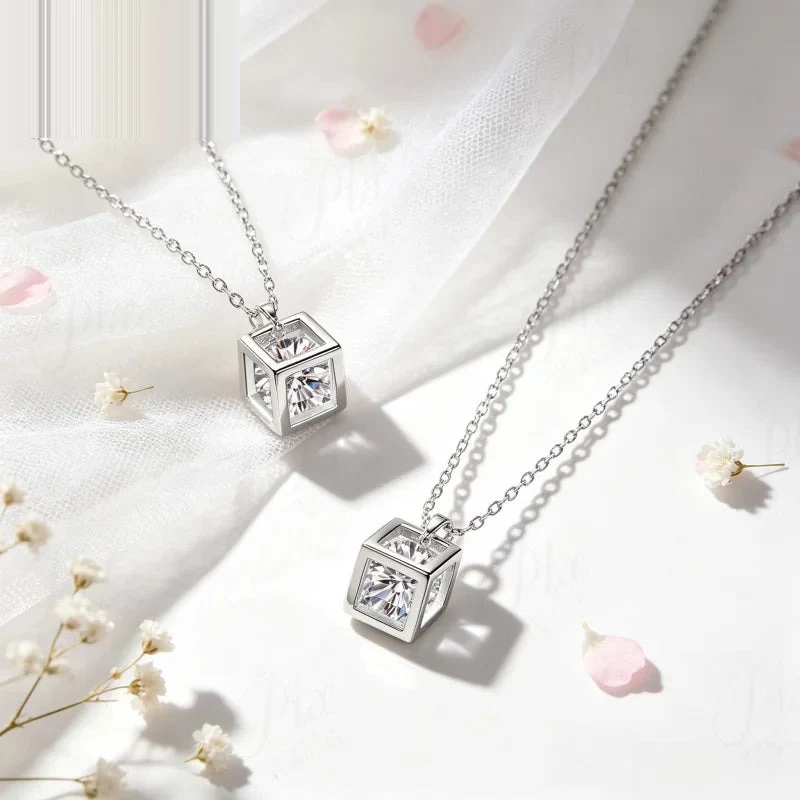
A bail that is too narrow for the chain gauge forces the pendant to stand on edge. The stone then rotates and the heavy side drops forward. A bail that is too wide lets the pendant slide around the link and swing. The interior width of the bail should be roughly 1.6 to 2.0 times the chain width. For a 1.0 mm cable chain, the bail interior should measure 1.6 to 2.0 mm; for a 1.5 mm figaro, plan on 2.4 to 3.0 mm inside. We build the head in CAD with the bail already scaled to the chain the buyer will ship with the piece, rather than drilling or filing it later.
The stone side itself is optical: we reference GIA's 4Cs framework for how cut and table size affect visible brilliance, even though moissanite is a separate mineral and is not graded by GIA.
Chain gauge by pendant weight
Stretching is the second failure mode. A thin chain under a heavy pendant elongates over months, the clasp pulls open, and the piece ends up on the floor. We use three gauge bands:
- Up to 2 g pendant (a 6 mm round solitaire on a slim head): 0.8 to 1.0 mm cable or figaro chain, 14K gold fill or solid 925 sterling.
- 2 to 6 g pendant (a halo or three-stone piece, 7 to 9 mm center): 1.2 to 1.5 mm figaro or rope chain; avoid snake chains at this weight.
- 6 g and above (a large cluster or a 10 mm-plus statement piece): 1.6 to 2.0 mm rope or box chain, preferably 14K solid rather than plate.
Rope and box chains have the best weight-to-link stiffness. Cable is the most popular for a 1 g solitaire but stretches fastest if overloaded. Our pendant chain and bail reference covers the same math for a single pendant; the necklace article extends it to station pieces.
Bail interior width and the flip problem
Beyond width, the bail opening must also be tall enough for the chain to lie through without binding. A bail that is too shallow turns the pendant into a pivot. We spec a minimum inside height of 2.5 mm on a 1 mm chain and 3.5 mm on a 1.5 mm chain. On open, or fish-hook, bails we check that the chain slides through the curved section, not only the hole. Buyers who want a fixed, non-moving pendant use a soldered jump ring between bail and chain, which removes rotation entirely.
Drop length and collarbone placement
The third variable is length. Most retail clients order a 40 cm (16 in) chain for a petite pendant, 45 cm (18 in) for a standard drop just below the collarbone, and 50 cm (20 in) for a lower, more casual placement. A 1.5 to 2.5 cm drop from bail to stone center is what makes a solitaire sit on the hollow of the neck rather than on the collarbone itself. We include the recommended chain length on the packing slip so the buyer does not have to measure it themselves. Our CAD proofing write-up shows how we model the bail and drop in 3D before wax so the proportions match the finished piece.
What chain gauge works with a 5 to 10 g pendant?
Plan on a 1.5 mm figaro or rope chain in solid 925 sterling or 14K gold. A 1.2 mm chain will look right in photos but will begin to stretch after roughly six months of daily wear at that weight.
How wide should the bail interior be?
Between 1.6 and 2.0 times the chain width, with a minimum inside height of 2.5 mm on a 1 mm chain. We build that ratio into the CAD model, not into a post-cast filing step.
Can you solder a larger bail onto an existing pendant?
Yes, but only on a solid-head pendant. We reserve this for repair orders; new custom pieces are built with the correct bail from the first casting.
What chain length do clients order most?
For a women's moissanite solitaire, 45 cm (18 in) is the most common. Men's station pieces run 50 to 55 cm.
Do you supply the chain with the pendant?
The pendant ships alone by default, but we can supply matched 925 sterling or 14K chains at wholesale. MOQ for a matched chain-and-pendant set is 5 units; the small-batch MOQ guide lists the per-unit price steps.
Send us the head sketch, the target pendant weight and the chain you will retail against it. We will return a CAD render with the bail already scaled, plus a matched chain quote, within three working days. Order your custom moissanite necklace set today.
Frequently Asked Questions
Is moissanite a good diamond alternative for retail buyers?
Yes for price-sensitive customers who want brilliance and hardness. Moissanite ranks 9.25 on the Mohs scale, holds up to daily wear and costs a fraction of a natural diamond of the same size, so it resells fast in bridal and fashion lines.
What is the minimum order for wholesale moissanite?
MOQ starts at 50 pieces per design for stock items. Custom cuts and private-label settings usually start at 100–300 pieces depending on the mold.
Do you provide certificates with moissanite stones?
Yes. Every parcel ships with GRA or IGI documentation listing carat weight, color grade and cut. We recommend passing the certificate to your end customer for trust.
How long does sample and bulk production take?
Samples ship in 3–5 days. Bulk runs take 15–20 days under 500 pieces, and 25–30 days for custom work.