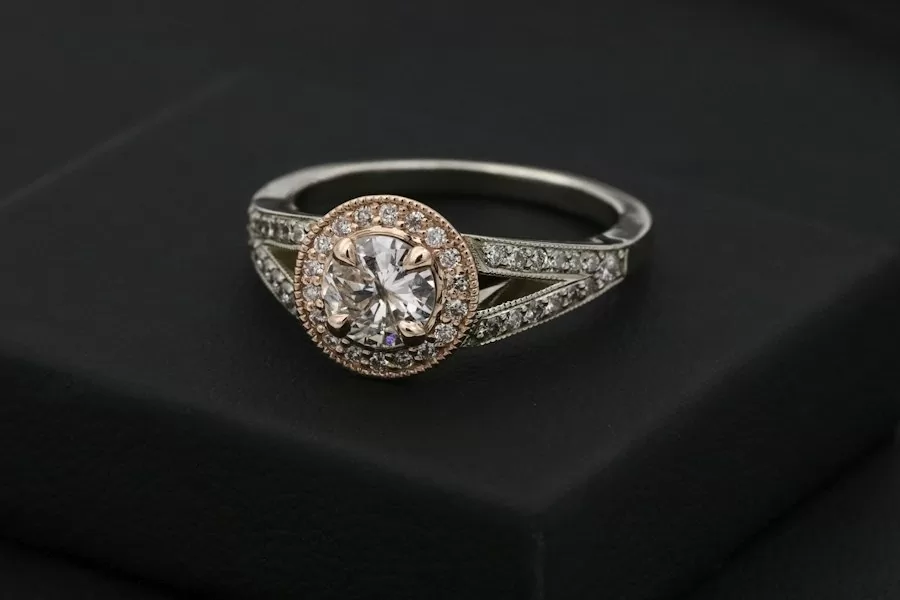
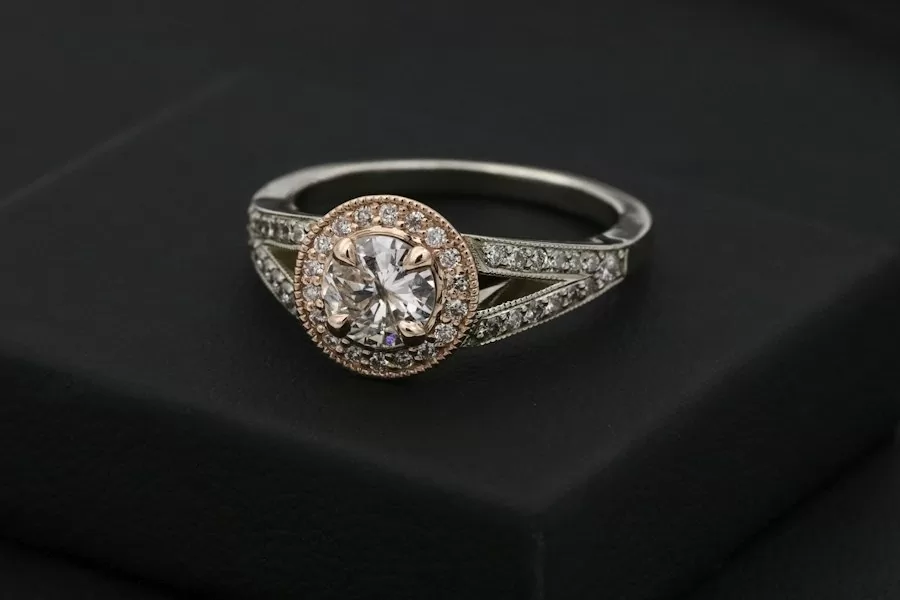
Walk into any engagement counter today and you will see the familiar solitaire holding court in the center case. But if you linger, a quieter design keeps showing up beside it: the three-stone ring. Often called the trinity or trilogy ring, it places a larger center stone between two slightly smaller companions, and couples keep gravitating toward it because it tells a story rather than just showing off a rock. At MoissaCustom, we build these in 925 sterling silver set with moissanite, which lets customers buy the meaning without the diamond price tag.
What the three stones actually mean
The classic reading is simple: the left stone is the past, the center is the present, and the right stone is the future. It is a compact way of saying "every version of us." Jewelers sometimes extend the metaphor to friendship, love, and devotion, or to a couple's first date, their proposal, and the life they are about to build. The exact wording matters less than the fact that the design invites a conversation, and that conversation is what turns a purchase into a keepsake.
Because the meaning is flexible, the style also works far beyond engagements. Anniversary bands, push presents, and even right-hand treat-yourself rings all borrow the layout. A customer who will never wear a diamond can still wear three moissanites and keep the symbolism intact.
Why moissanite suits this layout
Three-stone settings spread light across the finger, and moissanite's fire handles that job beautifully. A solitaire concentrates brilliance in one spot; a trilogy distributes it, so you want side stones that flash and sparkle rather than disappear. Moissanite refracts more white light and colored fire than a typical diamond of the same size, which makes the two flanking stones read as deliberate rather than filler. On a tighter budget, pairing a one-carat-equivalent center with 5x4mm side stones gives the look without paying three times over.
The metal choice matters too. Our three-stone pieces ride on 925 sterling silver, which is firm enough to hold prongs securely yet gentle on sensitive skin. For customers who react to mixed alloys, sterling silver is the safer call than a plated fashion band. If they want a warmer tone, rhodium or gold plating over the silver base adds it without changing the hypoallergenic core.
Picking the right shape and proportion
Round center stones are the timeless pick, and they play well with round or pear-shaped side stones. Oval centers look longer and suit fingers on the slimmer side. Emerald-cut centers read architectural and modern, especially with tapered baguette companions for that crisp, linear feel. The mistake we see most often is oversized side stones that fight the center for attention. As a rule of thumb, each side stone should land between a third and a half of the center's weight, so the eye still knows where to land first.
Band width is the other lever. A 2mm shank feels delicate and bridal; a 3mm or 4mm band reads bold and contemporary. Men's three-stone versions tend to favor the wider band with channel-set stones that sit flush, catching light only when the hand moves.
Caring for a three-stone setting
More stones mean more prongs, and more prongs mean more places where soap, lotion, and pocket lint like to hide. A soft brush in warm soapy water once a month keeps the fire bright. Because the side stones sit low on the shoulders, customers should avoid wearing the ring while gardening or lifting, where a corner can catch. Periodic prong checks at a local jeweler cost little and save stones. For deeper care notes, our sterling silver ring cleaning guide walks through the whole routine.
Who buys a three-stone ring
The demographic is wider than you would expect. Engaged couples in their late twenties and early thirties buy it for the symbolism. Parents buy smaller versions for milestone birthdays. Designers and writers love it for the narrative quality. And a growing share of buyers are women treating themselves, choosing three stones to mark a career leap, a graduation, or a hard-won sense of self.
If a customer is choosing between a solitaire and a trilogy, ask what they want the ring to say. A solitaire says "look at this." A trilogy says "look at us." The answer usually points one way.
The bottom line
The three-stone moissanite ring endures because it bundles sentiment, sparkle, and restraint into one balanced design. It is not the loudest ring in the case, but it is often the one people remember wearing years later. Built on 925 sterling silver with well-moissanited stones, it gives couples a story they can afford to actually live in. For more on how the center stone sits, our guide to solitaire, bezel, and pave settings pairs naturally with this one.
The 92.5% silver composition and properties of sterling silver are described in the Wikipedia entry on sterling silver.
Frequently Asked Questions
Is moissanite a good diamond alternative for retail buyers?
Yes for price-sensitive customers who want brilliance and hardness. Moissanite ranks 9.25 on the Mohs scale, holds up to daily wear and costs a fraction of a natural diamond of the same size, so it resells fast in bridal and fashion lines.
What is the minimum order for wholesale moissanite?
MOQ starts at 50 pieces per design for stock items. Custom cuts and private-label settings usually start at 100–300 pieces depending on the mold.
Do you provide certificates with moissanite stones?
Yes. Every parcel ships with GRA or IGI documentation listing carat weight, color grade and cut. We recommend passing the certificate to your end customer for trust.
How long does sample and bulk production take?
Samples ship in 3–5 days. Bulk runs take 15–20 days under 500 pieces, and 25–30 days for custom work.