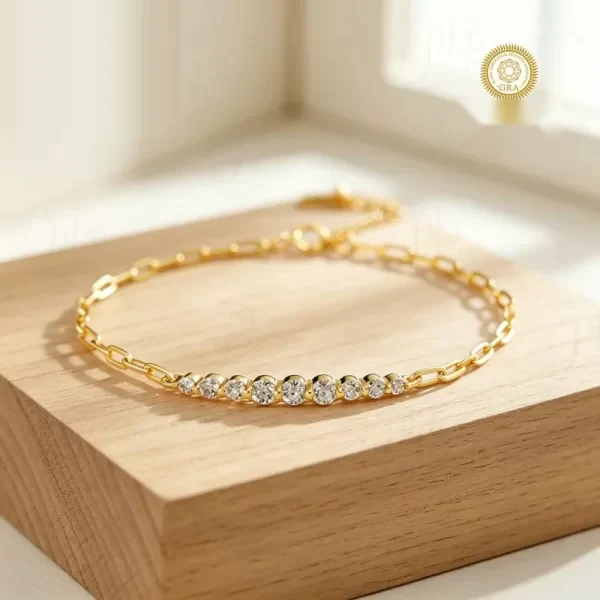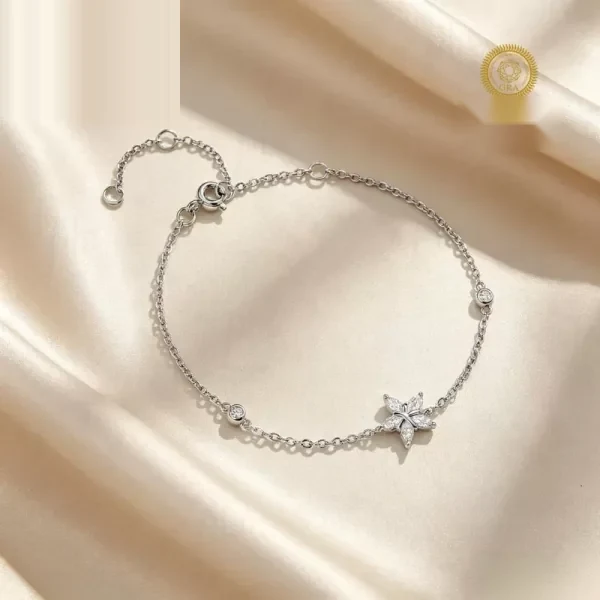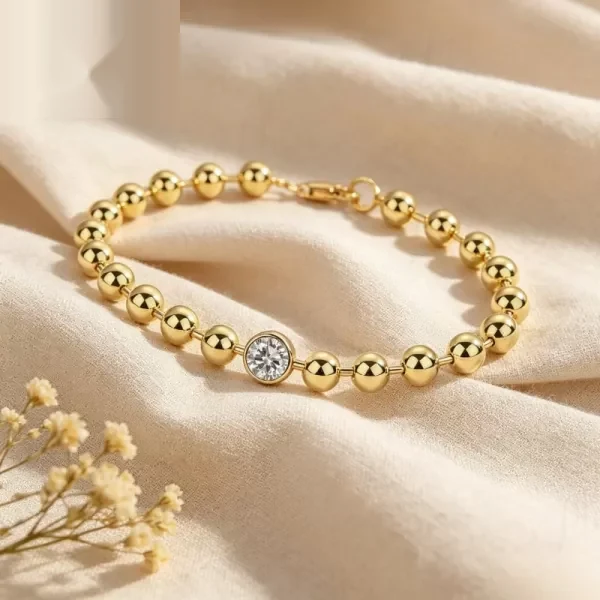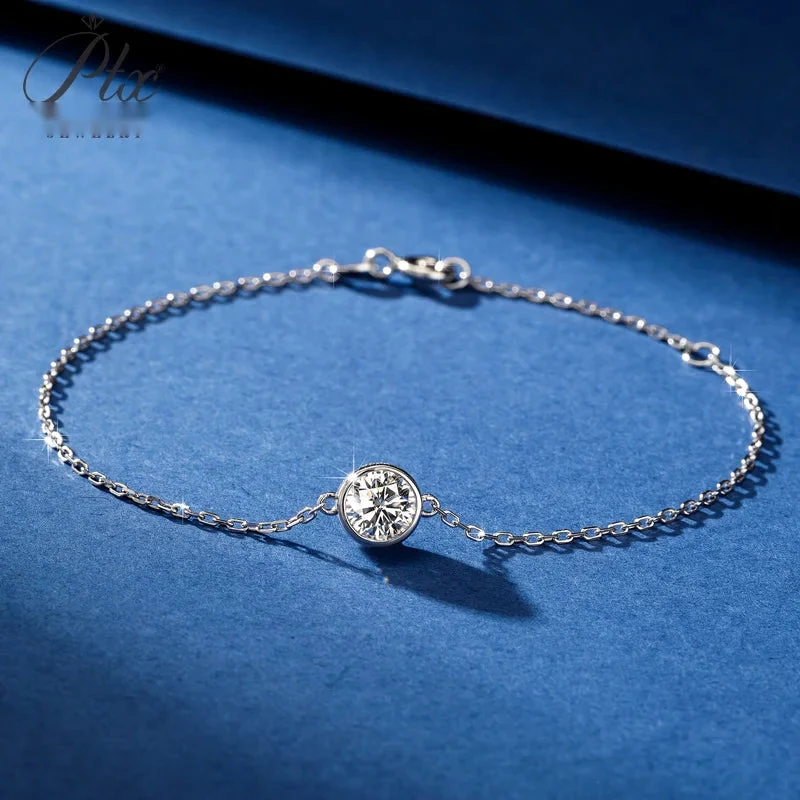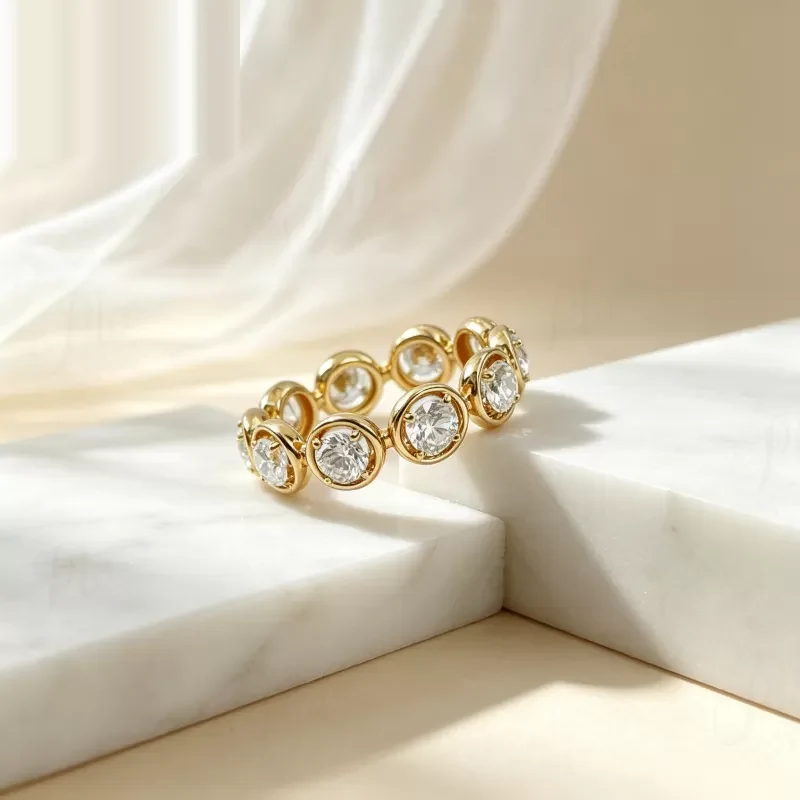
The tennis bracelet is the bracelet category in moissanite. It outsells every other bracelet style combined—cuffs, bangles, chains, charm bracelets—by a factor of roughly five to one in our wholesale data. The reason is simple: a tennis bracelet is a dressy piece that works with every outfit in every setting, from business meetings to weddings to jeans and a T-shirt. It is gifted for anniversaries, birthdays, graduations, push presents, and "just because." It photographs exceptionally well, it layers easily with watches and other bracelets, and moissanite's brilliance makes it look indistinguishable from a diamond tennis bracelet that would cost $5,000–$50,000.
For private label brands, the stock tennis bracelet designs available from most suppliers all look the same: 3mm rounds, channel set, silver with rhodium plate, 7-inch length, lobster clasp. The brands that build real moat in this category do it through customization—offering customers their choice of stone size, bracelet width, length, setting style, clasp, plating color, and accent details so the final piece feels like theirs rather than a generic drop-ship product. Custom moissanite tennis bracelet OEM at HOLYCOME lets brands configure every dimension of a tennis bracelet program, from standard stock-adjacent designs to fully bespoke pieces unique to their brand. This guide covers what can be customized, the width-to-stone-size proportions that work, MOQ by customization tier, pricing, lead times, and the QC checks that prevent the two most common tennis bracelet failures: stones falling out and clasps opening unexpectedly.
Tennis Bracelet Anatomy
A classic tennis bracelet is a continuous line of identically sized stones set in a flexible metal channel or link structure, connected so the bracelet drapes smoothly around the wrist. The critical dimensions are:
- Stone diameter: The size of each individual stone, measured in millimeters. Common sizes for tennis bracelets range from 2mm (delicate) to 5mm (substantial statement).
- Number of stones: Determined by stone diameter and bracelet length. A 7-inch bracelet with 3mm stones uses approximately 55 stones; with 4mm stones, approximately 40–42.
- Bracelet width: The visible width of the bracelet across the wrist, determined by stone diameter plus setting metal on each side. A 3mm stone bracelet is typically 3.3–3.8mm wide; a 4mm stone bracelet is 4.3–4.8mm wide.
- Total carat equivalent: Total stone weight across the bracelet. A 7-inch 3mm bracelet is approximately 6–7ct total; 4mm is approximately 10–12ct total; 5mm is approximately 18–22ct total.
- Length: Wearable circumference of the bracelet including clasp. Standard women's lengths are 6.5", 7", and 7.5". Men's bracelets are 8" and 8.5".
- Clasp: Closure mechanism (see clasp guide for detailed comparison).
Customizable Elements
Stone Size and Total Carat Weight
The single biggest driver of bracelet look and price. Common configurations:
| Stone size | Stones per bracelet (7") | Total carat approx. | Look | Retail price target |
|---|---|---|---|---|
| 2.0mm | ~85 stones | ~2.5ct | Ultra-delicate, subtle sparkle | $150–$250 |
| 2.5mm | ~70 stones | ~4ct | Delicate everyday | $200–$350 |
| 3.0mm | ~55 stones | ~6–7ct | Classic everyday (most popular) | $280–$480 |
| 3.5mm | ~48 stones | ~8–9ct | Bold, noticeable | $380–$650 |
| 4.0mm | ~42 stones | ~10–12ct | Statement piece | $500–$850 |
| 5.0mm | ~33 stones | ~18–22ct | Red-carpet / men's | $800–$1,500 |
For brands launching their first tennis bracelet program, 3mm is the safe starting volume size—it is the most popular size across every market and age group. Add 2.5mm for delicate layering customers and 4mm for statement buyers; that three-size ladder covers 90% of the market.
Setting Style
Tennis bracelets use one of four setting styles, each with a distinct look and security profile:
- Channel set: Stones sit in a continuous metal channel with no prongs between stones; two parallel metal walls hold each stone from the sides. The cleanest, most classic look. Strong security (stones are protected on both sides by the channel wall). Slightly less sparkle because metal partially covers stone edges.
- 4-prong set: Each stone is held by four tiny prongs (shared between adjacent stones for efficiency). More sparkle because more of each stone is exposed; slightly more vintage/traditional look than channel. Prongs can catch on fabrics if not properly smoothed.
- Bezel set: Each stone is surrounded by a thin metal rim. The most secure setting and the most modern/minimalist aesthetic; no prongs to catch. Popular in men's and contemporary designs. Less brilliance than prong because more of the stone edge is covered by metal.
- Half-bezel / u-bar: A modern hybrid where each stone is held by two parallel bars on opposite sides (usually top and bottom), leaving the sides open for maximum light entry. Clean modern look with strong security. Increasingly popular with DTC designer brands.
Bracelet Link Construction
How the bracelet flexes around the wrist is determined by link construction:
- Traditional linked cups. Each stone sits in its own small cup, and adjacent cups are connected by tiny links or pins. Maximum flexibility, drapes beautifully on any wrist shape. This is the construction used in 90% of quality tennis bracelets.
- Flex-bar. A continuous flexible steel or silver wire runs through the length of the bracelet, passing through the base of each stone setting. Allows flex but has a smoother, more uniform drape. Popular in ultra-thin designs.
- One-piece channel. Rigid continuous channel cut into a single piece of metal (hinged at 2–3 points). Used in rigid cuffs and some entry-level fashion bracelets; not recommended for quality tennis bracelets because it does not drape well.
Clasp and Safety
We recommend box clasps with double safety latches plus safety chains for all custom tennis bracelets, at every price point. Lobster clasps are available as a cost-reduction option for entry-level fashion styles but are not recommended for premium bracelets due to spring fatigue over time. (See our clasp types guide for full comparison.) Figure-8 clasps and hidden slide clasps are available as premium upgrades.
Length Options
Stock at least three women's lengths: 6.5, 7, and 7.5 inches. A 7-inch bracelet fits roughly 70% of women and should be your default stock and product page selection. Add an adjustable extension chain (1 inch) for bracelets marketed as "one size fits most" if you don't want to stock multiple lengths. Men's tennis bracelets stock at 8 inches with 8.5 inches secondary.
Metal and Plating
Standard production uses nickel-free 925 sterling silver with plating options: rhodium (bright platinum-white), 18K yellow gold, 18K rose gold, black rhodium, and two-tone combinations. Solid gold (10K, 14K, 18K white/yellow/rose) is available for premium lines at 20-piece MOQ. We also produce two-tone designs (e.g., white gold finish with yellow gold accents on clasp and ends, or a single yellow-gold station among white stones). Vermeil (2.5+ microns of gold over silver) is available for brands wanting gold look with heavy-duty plating durability.
Accent and Signature Details
Custom signature elements that make a bracelet program distinct include: accent stations (a colored stone, a slightly larger stone, or a gemstone every 10th stone), logo-engraved clasp, custom end caps, engraved dedication plate on the clasp interior, hidden surprise stones set into the clasp, and mixed-metal or mixed-stone patterns (alternating white and black moissanite, for example). These small touches are what make a bracelet recognizable as your brand rather than a generic product.
Width and Stone Size Proportions
Stone size and bracelet width should be proportional—mismatched proportions make a bracelet look cheap even if the stones are high quality. Follow these guidelines:
| Stone size | Bracelet width (silver) | Metal weight (7") | Thickness |
|---|---|---|---|
| 2.0mm | 2.3–2.6mm | 4–5g | 1.8–2.0mm |
| 2.5mm | 2.8–3.1mm | 5–6.5g | 2.0–2.2mm |
| 3.0mm | 3.3–3.8mm | 6–8g | 2.2–2.5mm |
| 3.5mm | 3.9–4.3mm | 8–10g | 2.5–2.8mm |
| 4.0mm | 4.4–4.8mm | 10–13g | 2.8–3.2mm |
| 5.0mm | 5.4–6.0mm | 14–18g | 3.2–3.8mm |
Stones that are too large for the bracelet width (e.g., a 5mm stone in a 4.8mm wide setting) are not secure and will loosen or fall out. Our CAD team designs every custom tennis bracelet with stone-to-width ratios within safe limits; we will flag any client-proposed design that falls outside safe proportions before production begins.
Color and Fancy Stone Options
While white colorless (DEF) moissanite dominates tennis bracelet volume, colored options are increasingly popular and can differentiate a brand's line:
- Black moissanite (treated): highly popular for men's bracelets and edgier women's styles
- Grey moissanite (natural grey): modern, moody alternative to white
- Champagne/cognac: warm vintage look, pairs well with yellow gold plate
- Green, blue, yellow, pink (coated fancy colors): fashion/statement colors
Popular color-accent patterns include: all-color bracelet, gradient (light to dark), center colored stone flanked by white, alternating white and black (chess pattern), and single colored station every 10th stone. Colored moissanite is identically priced to white for standard treated colors; some specialty colors carry a $3–$8 per unit premium.
MOQ and Pricing
| Customization level | MOQ | Lead time | Wholesale price range (3mm, 7") |
|---|---|---|---|
| Stock model, choose plating color/length only | 5 pieces/length/color | 7–10 days | $55–$75 |
| Modified stock (different stone size) | 20 pieces | 12–18 days | $55–$120 (varies by stone size) |
| Full custom (your CAD, setting, details) | 50 pieces | 21–28 days | $75–$180 |
| Custom with signature details | 50 pieces | 25–30 days | $85–$220 |
| Solid gold custom | 20 pieces | 30–45 days | $300–$800+ |
Per-piece price scales significantly with stone size and metal weight, since both moissanite and silver are priced by weight/quantity. Our wholesale team provides a detailed quote based on your exact stone size, setting style, length, metal, plating, and order volume. All prices are FOB and include standard OPP bag packaging; velvet pouches, jewelry boxes, and custom branded packaging are available at additional cost.
Tennis Bracelet QC
Custom moissanite tennis bracelets go through a 15-point QC process that includes our standard jewelry checks plus bracelet-specific inspections:
- Stone count verification. Every bracelet is checked to confirm the correct number of stones (none missing from settings).
- Stone pull test. Every individual stone is pull-tested at 200g force (stronger than clothing snags).
- Link flexibility. Bracelet is flexed through full range of motion to confirm no stiff links and smooth drape.
- Clasp function. Clasp is opened and closed 10 times, checking crisp click, safety latch snap, and security under 20lb lateral tension.
- Safety chain attachment. Safety chain confirmed soldered at both ends and strong enough to hold bracelet weight.
- Clasp/stone alignment. When closed, the clasp area must align with the stone line without a visible gap or step that catches clothing or hair.
- Stone alignment and spacing. All stones must sit at the same height with even spacing; no crooked or rotated stones.
- Polish and finish consistency. High polish areas consistently bright, matte areas evenly finished with no high spots.
- Plating adhesion (one per lot). Crosshatch and salt-spray test confirms plating durability.
- Length verification. Bracelet measured to confirm correct wearable circumference (±0.1 inch tolerance).
- Weight check. Weight matches specification (±5%); underweight bracelets indicate under-spec metal or smaller stones.
- Stamp clarity. 925 stamp and any custom logo stamp clearly visible on clasp or end cap.
- End cap security. End caps (where the clasp attaches to the stone line) must be cleanly integrated with no gap.
- Drape test on wrist mandrel. Bracelet placed on wrist-form to confirm it sits flat without twisting or gapping.
- Final sparkle inspection. Under 5500K daylight, all stones sparkle evenly; any dead/dull stone (from incorrect seat depth or foil-back issue) is replaced before shipment.
Across 14,000+ custom tennis bracelets shipped in 2025, our post-delivery defect rate was 0.3% (loose stone, clasp issue, or plating concern). Any defective unit is replaced free of charge with express shipping.
Bracelet Care for End Customers
Tennis bracelets are durable but not invincible. We provide a care card with every wholesale order recommending that customers:
- Remove bracelets before swimming, showering, exercising, or sleeping (chlorine, soap residue, and pressure can damage settings and plating over time)
- Fasten safety chain in addition to the clasp every time they wear it
- Store bracelets flat in a jewelry pouch, not hanging (which stretches the bracelet over time)
- Clean with warm water and mild soap, soft toothbrush to gently brush between stones; avoid ultrasonic cleaners on plated pieces
- Have stones and prongs checked by a local jeweler once per year
Brands can customize care cards with their own logo and brand messaging; we provide care card templates in the OEM packaging catalog.
FAQ
What is the best stone size for a tennis bracelet?
3mm (6–7ct total for a 7-inch bracelet) is the most popular size globally and a safe default for a first program. 2.5mm for delicate layering customers and 4mm for statement buyers complete the core three-size ladder.
What is the MOQ for custom moissanite tennis bracelet OEM?
5 pieces per length/color for existing stock models, 20 pieces for stone-size modifications of existing designs, and 50 pieces for fully custom designs from your CAD or sketch.
What clasp do you recommend?
Box clasp with double fold-over safety latch plus safety chain on every tennis bracelet at every price point. It is the most secure, most durable clasp for everyday wear. Lobster clasps are a budget option we offer but do not recommend.
What length should I stock?
Stock 7 inches as the default (fits ~70% of women), 6.5 and 7.5 inches as secondary sizes. For men's lines, stock 8 inches primary and 8.5 inches secondary. Alternatively, use 1-inch extender chains to make one size work for most wrists.
Can bracelets be sized after purchase?
Tennis bracelets can be shortened by a local jeweler (removing 1–3 links) for roughly $20–$40. Lengthening requires adding matching links and is not practical after production. We recommend that customers between sizes choose the longer length and have it shortened.
Do bracelets come with a warranty?
We provide a 1-year workmanship warranty for manufacturing defects for all wholesale accounts. Loose stones, clasp failure from defective manufacturing, or plating adhesion failure within the first year are repaired or replaced free. Damage from wear, impact, or improper care is not covered but is repairable at reasonable cost.
A well-made custom moissanite tennis bracelet is a SKU that stays in a brand's catalog for years and becomes a recurring best-seller across seasons. Customers who buy one often come back for a second size or a gift for a family member. Investing in proper clasp selection, correct stone-width proportions, and rigorous QC at production means those customers are happy customers who repurchase. Request our tennis bracelet OEM spec sheet or send us your CAD/sketch for a quote and sample.
The definition of carat weight and how it is measured are set out in the Wikipedia entry on carat weight.
Related reading: Custom Moissanite Tennis Bracelet OEM Width Length, Custom Moissanite Tennis Bracelet Factory Guide, Custom Moissanite Tennis Bracelets OEM Manufacturer.