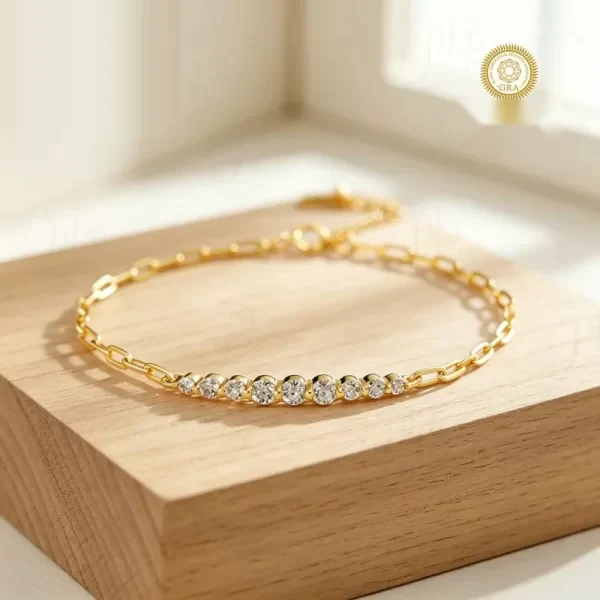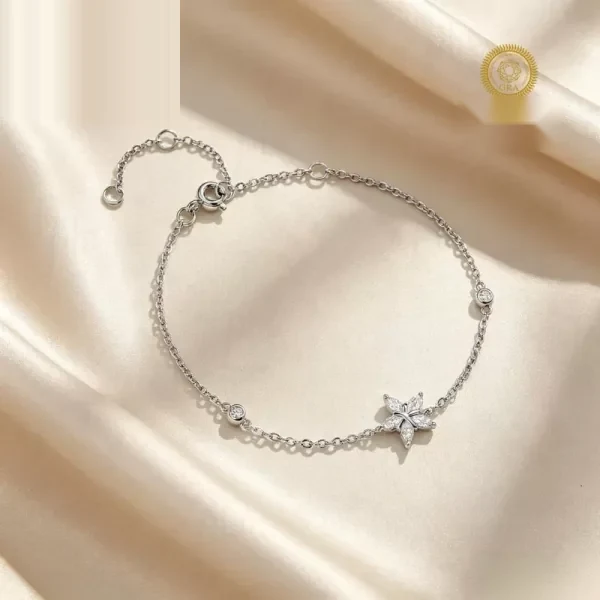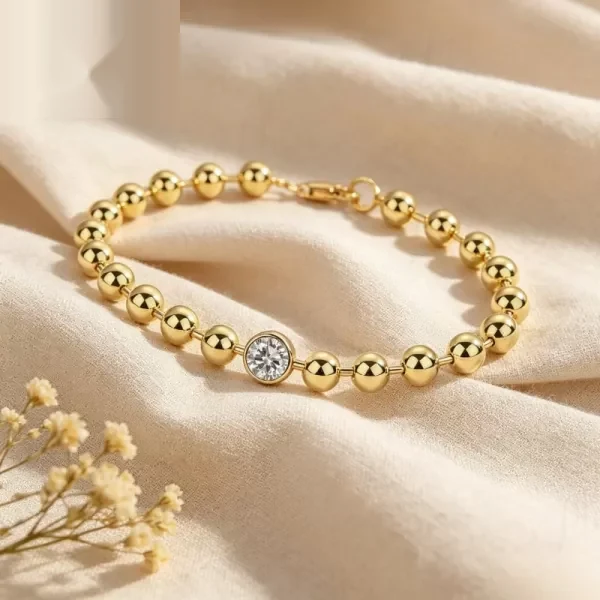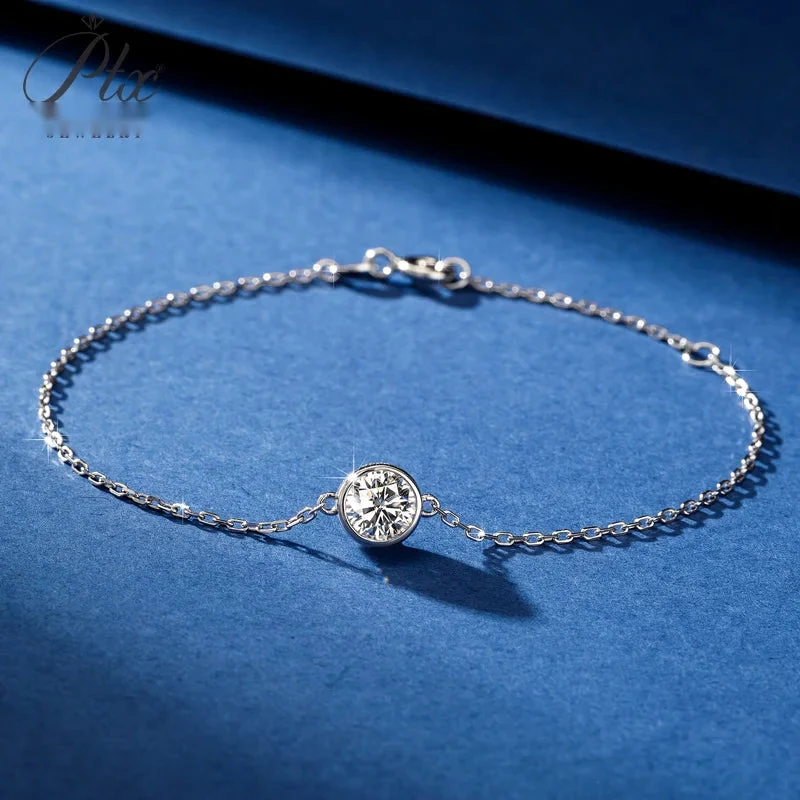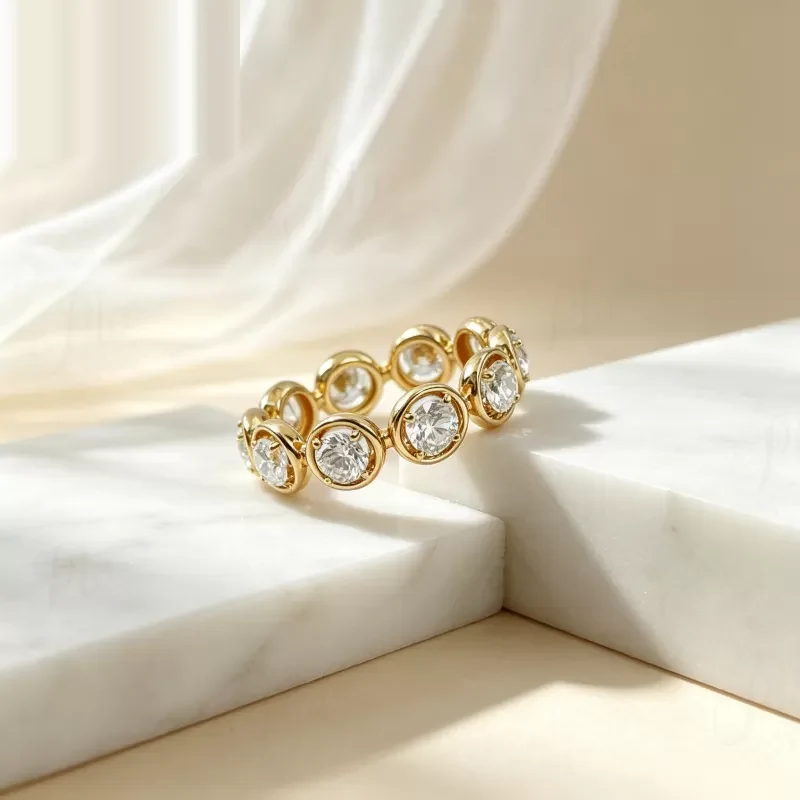
A Miami-based fine jewelry brand came to us in mid-2025 with a tennis bracelet concept that filled a gap they saw in the market. Standard tennis bracelets use uniform round stones in a single row; they wanted an alternating round and baguette moissanite pattern in a slim 2.5mm width, 14K white gold, with a hidden box clasp that sat flush with the bracelet. They had received a quote from a US manufacturer at $890 per unit, which put retail at $2,400—higher than their target customer would pay. We reverse-engineered the design: sourced calibrated baguette and round moissanite matched for color and clarity, engineered a channel setting that held both stone shapes securely, and developed a custom flush-fit box clasp with double safety latches. The final unit price was $205 in 14K white gold at 100 pieces, retailing at $1,195. The bracelet sold 350 units in the first two months and has been reordered three times.
Custom moissanite tennis bracelets are a statement category—brands that nail a custom tennis bracelet design create an instantly recognizable signature piece. They also carry unique manufacturing challenges not present in rings, earrings, or pendants: every stone must be perfectly aligned across dozens of settings, the bracelet must flex smoothly around the wrist without gaps, clasps must be invisible yet secure, and the entire piece must lay flat without twisting. This guide covers what goes into custom tennis bracelet manufacturing, the engineering decisions that determine wearability and quality, and how to specify bracelets that look spectacular and hold up to daily wear.
Why Custom Tennis Bracelets Are Difficult to Manufacture Well
The tennis bracelet appears simple—a continuous row of stones set in a flexible band—but manufacturing excellence requires precision across dozens of individual settings that must align perfectly with each other. A ring has one center stone (plus accents); a 7-inch tennis bracelet has 40-80 individual stones depending on size. Every single stone must be set at the same height, at the same angle, with the same amount of metal visible. Even 0.1mm of misalignment between adjacent stones creates a visible gap or a raised stone that catches light differently and looks wrong.
Flexibility adds another layer of complexity. A ring is rigid; a tennis bracelet must flex to wrap around the wrist, bend and straighten as the wearer moves, and lay flat against the skin in all positions. The links between settings must be tight enough that no gaps appear when the bracelet is straight but loose enough to flex smoothly. Too tight and the bracelet feels rigid and uncomfortable; too loose and gaps appear between stones when the bracelet is worn. This balance requires precise link geometry that varies based on bracelet width, stone size, and metal type.
Clasps are the most common failure point. A tennis bracelet clasp must be secure enough that the bracelet will not fall off if accidentally tugged, but easy enough for the wearer to operate one-handed. It must also sit flush with the bracelet so there is no visible break in the stone line. Box clasps with figure-8 safety latches are the industry standard for fine tennis bracelets, but they require precision machining to operate smoothly. A poorly made box clasp sticks, is hard to close, or pops open unexpectedly.
GIA provides standards for diamond and moissanite grading that apply to tennis bracelet stones, with one critical addition: tennis bracelet stones must be perfectly calibrated (all identical dimensions within 0.02mm) to create the uninterrupted line of sparkle that defines the style. Even slightly oversized or undersized stones cause uneven spacing and visible misalignment. We calibrate every moissanite for tennis bracelets individually, matching them within 0.02mm diameter and selecting stones from the same production batch for color consistency. Browse our moissanite tennis bracelet designs and learn about OEM custom bracelet programs.
Custom Tennis Bracelet Specification Comparison
Multiple design choices determine the look, price, durability, and comfort of a custom tennis bracelet:
| Specification | Option A | Option B | Option C |
|---|---|---|---|
| Stone size | 2.0-2.5mm (dainty, everyday) | 3.0-3.5mm (classic, most popular) | 4.0mm+ (statement, substantial) |
| Stones per 7" bracelet | 65-80 stones | 45-55 stones | 35-42 stones |
| Setting style | Channel set (stones in metal channel, smooth edges) | Prong set (4-prong per stone, maximum sparkle) | Bezel / half-bezel (modern, secure, clean) |
| Link type | Individual cup links (most flexible, classic look) | Continuous channel bar (rigid, sleek, modern) | Articulated bar segments (balance of flex and clean line) |
| Clasp type | Box clasp with safety (most secure, premium) | Lobster clasp (easy to use, visible) | Slide clasp with safety (sleek, less common) |
| Metal (most common) | 925 silver rhodium-plated | 14K white gold | 14K yellow / rose gold |
| Unit price (7", 3mm stones, 50pc) | Silver: $45-$75 | 14K white gold: $175-$290 | Platinum: $550-$850 |
| Bracelet widths | 2.5mm (slim, stackable) | 3.5-4mm (standard, substantial) | 5mm+ (statement, bold) |
| Common lengths | 6.5" (petite) | 7" (standard) | 7.5" (large wrist) |
| Stone loss risk (our QC data) | Channel: under 0.2% | Prong: ~0.8% lifetime | Bezel: under 0.1% |
Prices shown are for uniform round moissanite D/VVS1. Fancy shape patterns (alternating rounds and baguettes, graduated sizes, alternating shapes) add 15-30% to unit cost due to setting complexity and additional stone matching requirements. Mixed metal and two-tone designs add 20-35%. We always provide specific pricing after reviewing your design brief. The tennis bracelet's history dates to Chris Evert's 1978 US Open diamond bracelet incident; modern moissanite versions deliver the same iconic look at a fraction of diamond pricing.
Custom Tennis Bracelet Design Options
Beyond the standard single-row round stone design, custom tennis bracelets can incorporate distinctive design elements:
Graduated sizing. Stones increase in size toward the center and decrease toward the clasp, creating a subtle focal point at the top of the wrist. Graduated bracelets require precise stone size sequencing and create a more dimensional look than uniform sizing. They add approximately 10-15% to production cost due to the wider range of stone sizes needed.
Fancy shape patterns. Alternating round and baguette, round and princess, or all-emerald/all-cushion patterns create visual interest. The Miami client referenced earlier used an alternating round-and-baguette pattern. Fancy shapes require different seat geometry per stone type and tighter QC to ensure all stones sit at consistent height despite different shapes.
Mixed stone types. Combining moissanite with colored gemstones (sapphires, rubies, emeralds) or lab diamonds creates distinctive designs. Birthstone accents, colored stone patterns, or a single colored stone focal point differentiate your bracelet from commodity all-moissanite versions. Different stone hardnesses require different setting pressures—softer stones cannot be set with the same force as moissanite.
Multiple rows. Two-row or three-row tennis bracelets create a wider, more substantial look. Double rows add 80%+ to material cost and require inter-row alignment checks during setting. Three-row designs are substantial statement pieces typically 7-10mm wide.
Engraved or patterned bars. Introducing patterned metal segments between sections of stones (engraved lines, milgrain edges, textured sections) adds visual breaks and gives the bracelet a distinctive rhythm. These details are added during pre-polish and require tight tolerances to align consistently across all sections.
Adjustable length options. Extender chains (0.5-1 inch) with multiple rings allow customers to wear the bracelet at different lengths and accommodate different wrist sizes without requiring you to stock multiple lengths. Extenders add $3-6 per unit and reduce SKU complexity.
Clasp Engineering for Custom Tennis Bracelets
The clasp is the most engineered component of a tennis bracelet and deserves focused attention during custom design:
- Box clasp with figure-8 safety: The gold standard for fine tennis bracelets. A tongue slides into a precision-fit box, and a figure-8 shaped safety latch clips over the clasp for double security. Requires precision machining (0.02mm tolerance) to operate smoothly. When made well, it is completely invisible from the top—stones run uninterrupted over the clasp. We recommend this clasp for all gold tennis bracelets over $300 retail.
- Lobster clasp: Easier for customers to operate one-handed, but it creates a visible break in the stone line where the clasp attaches via jump rings. Better for fashion tennis bracelets at lower price points or for customers who struggle with box clasps. Use 10mm+ lobster clasps for bracelets over 15 grams total weight.
- Slide clasp / magnetic clasp: Magnetic clasps are easy to use but not secure enough for valuable pieces. Slide clasps (push-button release) provide security and easy operation but are bulkier than box clasps. Neither is recommended for premium tennis bracelets.
- Integration with design: For custom bracelets, the clasp must be designed as an integral part of the piece, not an afterthought. We design clasps that match the setting style—channel-set bracelets have channel-pattern clasps; prong-set bracelets have clasps set with matching stones to maintain the continuous look.
Every clasp we produce is tested for 200 open/close cycles during QC and pull-tested to ensure it does not open under 10lbs of force. Clasp failure is the number one reason tennis bracelets are lost; we treat clasp engineering as a safety-critical component. Read more about our clasp testing standards.
Custom Bracelet Quality Control
Tennis bracelets require more inspection steps than any other jewelry category due to the number of stones and moving parts:
- Calibration verification: All stones are measured with a digital micrometer before setting to confirm they are within 0.02mm of specified size. Out-of-spec stones are removed and replaced.
- Color matching: Stones are color-matched under D65 daylight against master color stones. One off-color stone in a 50-stone bracelet creates a visible color break. We ensure all stones per bracelet are within one color grade.
- Setting height alignment: After setting, every stone table is measured for height. Stones that sit 0.05mm higher or lower than adjacent stones are reset. This is checked using a dial indicator across the full length of the bracelet.
- Flex test: Each bracelet is flexed through 20 full open/close cycles around a mandrel to check link smoothness, no binding, no stiff links, and no gaps between stones when laid straight.
- Lay-flat test: Bracelets are laid on a flat granite surface and checked for any twist, wave, or gap that indicates uneven link tension. A bracelet that does not lay flat will twist on the wrist.
- Stone probe test: Every stone is individually probed under 10x magnification to check for looseness. Even a single loose stone requires re-setting.
- Clasp operation test: Each clasp is opened and closed 20 times to confirm smooth operation and positive lock. Safety latches must click securely into place. Pull-test confirms the clasp holds 10lbs.
- Edge and finish check: All edges are checked for smoothness—tennis bracelets slide on and off the wrist and catch on clothing if edges are sharp. Polishing is checked across all links for consistency.
- Length verification: Bracelet length (including clasp) is measured and verified to within ±0.1 inches of specified length.
Our custom tennis bracelet defect rate runs under 1.0%, higher than other categories due to the complexity, but well below industry averages of 3-5%. The most common issue we catch in QC is a single stone set slightly high or low, which we correct before shipment.
Frequently Asked Questions
Q: What is the MOQ for custom moissanite tennis bracelets?
A: 50 pieces per custom bracelet design. One-off silver prototypes are $80-$150 depending on width and stone size. Small batch runs of 20 pieces are available at 25% premium for initial market testing. Reorders of existing custom designs start at 30 pieces. Custom bracelets can be ordered in multiple lengths (6.5", 7", 7.5") with MOQ applied per length.
Q: How long does custom tennis bracelet production take?
A: CAD design 7-10 days, prototype 10-14 days (tennis bracelet prototypes require more precision than rings), mold creation 7-10 days, bulk production 25-30 days. Total timeline from design kickoff to delivered bulk order is typically 9-11 weeks—slightly longer than other categories due to setting complexity and link mold requirements. Rush programs available at 25% surcharge for 7-8 week delivery.
Q: Can custom tennis bracelets be sized after purchase?
A: Tennis bracelets can be shortened by removing links (relatively straightforward) but cannot be lengthened without adding matching links from the same production batch. We recommend producing extra links (2-3 per bracelet) that retailers can use for sizing adjustments. Some brands offer extender chains (sold separately) rather than stocking multiple bracelet lengths.
Q: Can you produce custom tennis bracelets with lab diamonds instead of moissanite?
A: Yes. We can produce the same bracelet designs with lab-grown diamonds (HPHT or CVD) in D-F color, VS-SI clarity. Lab diamond versions are approximately 4-6x the cost of equivalent moissanite in sizes up to 3mm, widening at larger sizes. Lead time for lab diamond bracelets adds 1-2 weeks for stone sourcing. IGI certification is available for lab diamond pieces at additional cost.
Q: What if a stone falls out after purchase?
A: Our 12-month manufacturing warranty covers any stone loss due to setting defects. After the warranty period, stone replacement is available as a repair service. Channel and bezel settings have extremely low stone loss rates; prong settings require occasional prong retipping after years of wear, which we recommend customers have done by a local jeweler.
Q: Can I order matching bracelet + necklace sets?
A: Yes. Custom tennis bracelets can be designed to match custom tennis necklaces using the same stone size, setting style, and clasp mechanism for a coordinated look. Set orders share mold setup costs for common components (cup links, clasp hardware) reducing overall tooling fees by 20-30% compared to ordering separately.
Key Takeaways for Custom Moissanite Tennis Bracelets
Custom tennis bracelets are statement pieces that become brand signatures, but they require the highest manufacturing precision of any jewelry category:
- Stone calibration within 0.02mm is essential—misaligned stones create visible gaps
- Clasp engineering is safety-critical; use box clasps with figure-8 safety for premium pieces
- Link geometry must balance flexibility with gap-free stone alignment when laid straight
- Tennis bracelets take 9-11 weeks to develop—longer than rings or earrings due to setting complexity
- Lay-flat testing on a flat surface catches twist and tension issues visual inspection misses
- Produce extra links for post-purchase sizing adjustments
- Channel and bezel settings have lower stone loss rates than prong settings for bracelets
- Matching bracelet + necklace sets reduce tooling costs by 20-30% when ordered together
If you have a custom moissanite tennis bracelet concept—a distinctive stone pattern, a unique clasp, a width or profile you cannot find in existing collections—send our design team your brief for a free feasibility review. We will assess stone calibration requirements, clasp engineering, link geometry, provide ballpark pricing, and walk through the development timeline. A signature tennis bracelet becomes one of the most recognizable pieces in a jewelry brand's collection; the engineering investment pays dividends in brand identity and customer loyalty. Start your custom bracelet project with HOLYCOME.