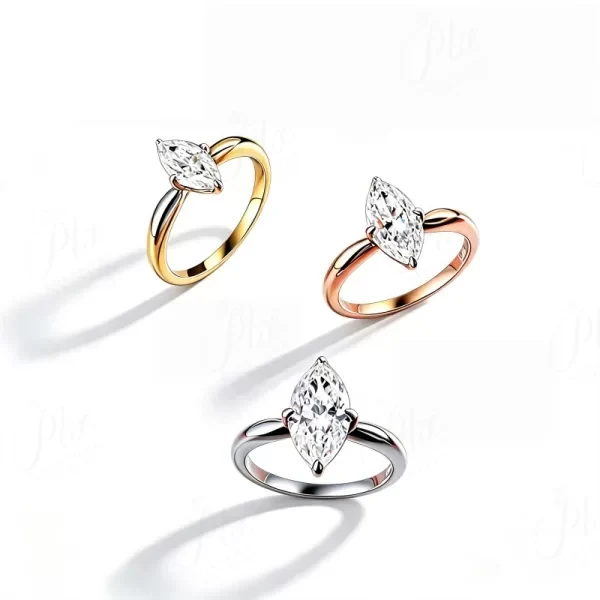
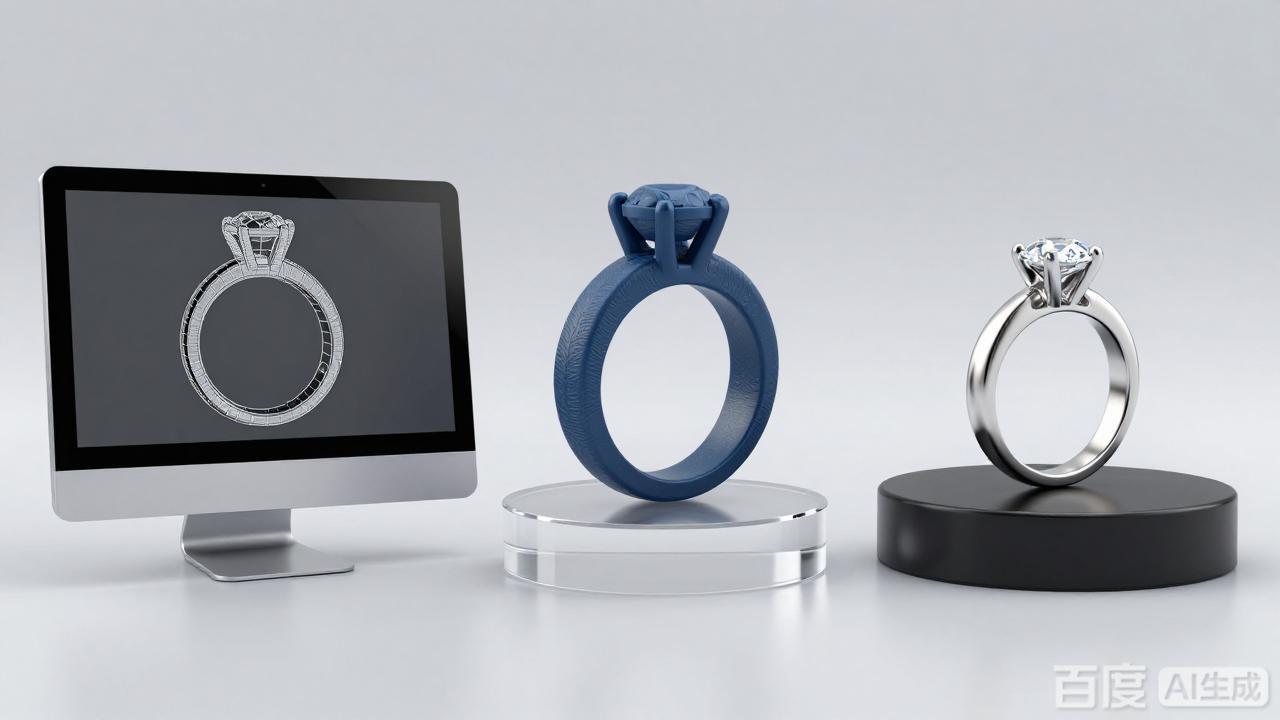
Every custom moissanite engagement ring begins as an idea in someone's mind—sometimes a pencil sketch, sometimes a Pinterest board, sometimes a photograph of a celebrity ring the customer wants to riff on, sometimes a napkin drawing from a brand designer who has a vision but cannot draw it to scale. Turning that idea into a wearable, durable, well-proportioned ring requires more than a good jeweler. It requires CAD: Computer-Aided Design. CAD is the bridge between concept and production, and it is the stage where proportions are finalized, stone seats are engineered, structural weaknesses are engineered out, and a ring moves from imagination to a precise 3D model ready for casting.
For custom moissanite engagement ring production at HOLYCOME, the CAD design process is the most important stage of the entire project. Errors or poor decisions made at the CAD stage cannot be fixed by good casting or setting; a ring that is structurally weak in CAD will break regardless of how well it is cast, and a ring with poor proportions in CAD will look wrong even if every stone is set perfectly. We treat CAD as a collaborative design phase where the client approves every dimension, every angle, and every stone position before anything physical is produced. This guide walks through the full CAD-to-finished-ring process, what you can expect at each stage, how revisions work, and how we ensure the ring you approve on screen matches the ring that arrives at your warehouse.
Why CAD Is Used for Custom Ring Design
Traditional jewelry was carved in wax by hand—a process called "lost-wax casting" that dates back thousands of years. Hand carving is still used for one-off artisan pieces, but it cannot deliver the consistency required for OEM private label production. CAD replaced hand carving for most production jewelry because it offers four advantages no hand carver can match:
- Precision to 0.01mm. CAD models are measured to hundredths of a millimeter. Stone seats are sized exactly to the stone diameter; band widths are consistent around the entire shank; settings are symmetric.
- Unlimited revisions before production. Changing a band from 2.0mm to 2.3mm in CAD takes 5 minutes. Changing it after casting requires filing, reshaping, and often re-casting. CAD revisions are fast and cheap; physical revisions are slow and expensive.
- Consistency across production batches. A CAD file can produce 10 or 1,000 identical rings with identical proportions, an impossibility with hand-carved waxes where every copy differs slightly.
- Photorealistic preview. Modern CAD software produces renderings that look almost identical to the finished ring, letting you approve proportions and stone sizes visually before committing to metal.
The CAD Design Process: Six Steps from Concept to Approved Model
Step 1: Brief and Reference Collection
Every custom ring project starts with a design brief. You provide any combination of: sketch drawings (even rough ones), reference photos of existing rings, Pinterest boards, a list of desired features ("halo with oval center, thin band, hidden diamond side detail"), stone specifications (center stone size and cut, accent stone size), metal preference, target ring weight, and target retail or wholesale price. We also need to know the ring's launch timeline and production MOQ, because that affects how quickly the CAD team prioritizes your project.
A good brief does not need professional drawings. Some of our best custom designs started from a customer's iPhone photo of a ring they saw on the street with three annotation arrows. What matters is communicating the key proportions and aesthetic feel, not technical precision.
Step 2: Stone Selection and Specification
Before CAD modeling begins, we lock in the center stone specifications: shape (round, oval, cushion, etc.), millimeter size, and color grade. The entire ring is designed around the center stone; stone seats in CAD must match the exact diameter of the production stones to within 0.02mm. If the center stone size changes after CAD is done, the head (prongs or bezel holding the stone) must be re-modeled to match.
Accent stones (halo stones, side stones, pavé stones) are also specified at this stage: size, cut, and spacing. We recommend moissanite accent stones in 1.0mm, 1.2mm, 1.3mm, 1.5mm, or 1.8mm diameters—these are the sizes our cutters produce in volume and they yield the best material efficiency and pricing. Halo designs typically use 1.0–1.3mm accent stones; side stone bands use 1.5–2.0mm; three-stone designs use 2.5–3.5mm side stones.
Step 3: Initial CAD Modeling (3–5 Days)
Our CAD designers work in Rhino 3D with jewelry-specific plugins (MatrixGold, RhinoGold) that include tools for pavé layout, prong generation, and realistic metal rendering. The first CAD draft includes:
- Band profile (knife edge, half-round, flat, comfort-fit, domed, European shank, tapered, etc.)
- Band width at top and bottom (bands typically taper or flare from head to shank bottom)
- Head design (prongs: 4-prong, 6-prong, double claw, basket; or bezel, halo, tension, semi-bezel)
- Stone seats sized to your specified stones
- Accent stone layout (pavé, channel, bead set, tension, hidden)
- Gallery details (filigree, open work, hidden halos, surprise stones under the center head)
- Overall dimensions and profile views
You receive a set of 6–8 high-resolution renderings of the ring from multiple angles: top view (head-on), profile (side), three-quarter perspective, finger view (on a rendered finger for scale comparison), and close-ups of details like the gallery or hidden stones. You also receive exact dimensions: band width at widest and narrowest points, setting height from finger, total expected metal weight, and total stone count.
Step 4: Revision Round(s)
One round of revisions is included in the standard CAD fee. This is where you adjust proportions, band widths, stone sizes, or details that don't look right in the renderings. Common revision requests include:
- "Make the band thinner/thicker at the bottom"
- "Change from 4-prong to 6-prong"
- "Add/reduce the halo thickness"
- "Raise/lower the center stone setting height"
- "Add a surprise stone under the center head"
- "Change to a cathedral shank instead of straight"
- "Reduce the size of the prongs"
Revisions are fast—usually 1–2 days per round—and one round is usually enough when clients have been specific in the original brief. Additional revision rounds beyond the first are billed at $30 per round, which keeps the process efficient without penalizing brands that need to iterate.
Step 5: Final CAD Approval
Once you approve the CAD renderings, the file is locked. We produce a wax 3D print (resin print, 25 micron layer height) for casting preparation. At this stage you also receive a production confirmation sheet listing every material, stone, and dimension specification; this becomes the spec sheet we QC against during production and is signed off by both parties.
Step 6: Wax Printing and Casting Preparation
The CAD file is sent to our in-house 3D wax printer (DLP resin printer using castable jewelry wax resin at 25 micron resolution). The printed wax is checked against the CAD dimensions before being attached to a wax tree for casting. This wax is the first physical incarnation of the ring, and we measure critical dimensions (band thickness, head height, stone seat diameter) against the CAD specs to confirm printing accuracy before casting.
| Stage | Timeline | Deliverable | Client action |
|---|---|---|---|
| Design brief | Day 1–2 | Written quote + brief confirmation | Share references, approve quote |
| Initial CAD | 3–5 days | 6–8 renderings + dimension sheet | Review, provide revision notes |
| Revisions | 1–2 days/round | Updated renderings | Approve changes or iterate further |
| Final approval | Day 8–12 | Locked CAD file, spec sheet | Sign off |
| Wax print | 2–3 days | Physical wax pattern | Optional (wax photos sent on request) |
| Sample production | 7–10 days after wax | Finished sample shipped to you | Inspect and approve for production |
Proportions and Engineering: What We Check in Every CAD Model
A good-looking rendering is not enough. CAD models must also be engineered for durability and wearability. Our senior CAD designer reviews every model for eight structural and ergonomic factors before the rendering is sent to the client:
- Shank durability. Band thickness at the bottom (the thinnest point after taper) must be at least 1.2mm for silver rings and 1.0mm for gold to resist bending under normal wear.
- Prong strength. Prongs must be thick enough at the base to hold the stone through years of wear but thin enough at the tip to look elegant from above.
- Setting height. A center stone set too high catches on clothing and feels unstable; set too low, it loses brilliance and can be damaged by impact. We set most engagement rings at 6.5–8.5mm from finger, depending on stone size.
- Comfort fit interior. The interior of the shank should have a slight dome (comfort fit) for comfortable daily wear, unless the client specifies a flat interior.
- Stone seat depth. Seats must hold stones deep enough to prevent chipping at the girdle but not so deep that the stone sits below metal and loses light from the sides.
- Weight distribution. The head should not be so heavy relative to the shank that the ring spins on the finger (a common problem in top-heavy halo rings).
- Pavé spacing. Pavé stones must be evenly spaced with sufficient metal between them to hold each stone securely without looking cluttered.
- Ring size scalability. The design must allow for sizing up or down 1–2 sizes without distorting design elements (particularly side stones and engraved details).
CAD for Common Engagement Ring Styles
Solitaire
The simplest CAD model: a tapered or straight band with a single head. Solitaires take the least time to model (2–3 days) and are the easiest to revise. The key CAD decisions are band profile (half-round, knife-edge, flat), band taper (how much it narrows from head to bottom), and prong style (4-prong round, 6-prong, or claw). Custom moissanite engagement ring solitaire projects start from roughly $80 mold fee and 50-piece MOQ.
Halo
Halo rings have a ring of smaller accent stones surrounding the center stone. CAD is critical for halo designs because the halo diameter must perfectly frame the center stone—too tight and stones overlap, too loose and the halo looks detached from the center. Pavé layout in CAD must also align perfectly around the circular or cushion-shaped halo.
Three-Stone
Three-stone rings require precise CAD work on the side stone angle and spacing relative to the center stone. The side stones should tilt slightly inward toward the center stone (tradition says they represent the past, present, and future of a relationship) and the prongs must be placed to avoid blocking adjacent stones.
Vintage / Filigree
Vintage-inspired designs use hand-engraved-looking details, milgrain edges, filigree open work in the gallery, and sometimes ornate side profiles. These details require fine CAD work and more wax printing precision. Vintage rings typically take 5–7 days of CAD time due to the detail density.
From CAD to Finished Ring: Production Timeline
| Step | Time after CAD approval |
|---|---|
| Wax printing and tree assembly | 2–3 days |
| Investment casting | 1 day |
| Devesting and sprue removal | 1 day |
| Pre-polish | 1 day |
| Setting (center stone + accents) | 2–4 days |
| Final polishing | 1 day |
| Plating (if applicable) | 1 day |
| Final QC | 1 day |
| Total sample production | 10–14 days |
| Full production batch (50+ pieces) | 21–28 days |
All moissanite stones used in custom rings are checked for optical performance before setting, per standard GIA-influenced moissanite grading criteria. Moissanite's refractive index of 2.65 (higher than diamond's 2.42) creates exceptional brilliance when stones are cut correctly, and CAD seats are designed to maximize light return by leaving the pavilion (bottom of the stone) exposed to light from the sides and back.
FAQ
What do I need to provide to start a custom ring CAD project?
At minimum: rough sketches or reference photos, center stone size and shape, metal type, and band width preference. You do not need to provide technical CAD files or professional drawings; our CAD team works from images and descriptions.
How many revisions are included in the CAD fee?
One revision round is included in the standard $80–$200 mold fee. Additional revisions are $30 per round. Most projects require zero or one revision beyond the initial draft.
Can I make changes after approving the CAD?
Before casting: yes, but additional changes after final approval are billed as a new revision and delay the project by 2–3 days. After casting: changes require re-casting and re-setting, which adds 7–10 days and costs additional fees. We strongly recommend careful review at the rendering stage before approving.
What software do you use for ring CAD?
Rhino 3D with MatrixGold and RhinoGold jewelry plugins, plus ZBrush for sculpted organic details. Renderings are produced in KeyShot for photorealistic metal and stone visualization.
Can I get a physical wax model before casting?
Yes. We can ship you the 3D-printed wax model for $25 + shipping before casting, for clients who want to physically see the proportions in 3D. Most clients approve from renderings; physical wax review is mainly used for high-detail vintage designs or large-stone halo designs.
Do you provide CAD files after the project?
Yes. Upon production order confirmation, we provide the final .3dm Rhino file and .stl for your records. For OEM clients with exclusive mold rights, the CAD file is considered your intellectual property and is never used for other customers.
The CAD stage is where custom rings are won or lost. Investing attention and feedback at the rendering stage is cheap and fast; fixing problems after metal has been cast is slow and expensive. We structure our custom moissanite engagement ring process to make CAD review as easy as possible—clear renderings from multiple angles, explicit dimension sheets, and fast revision turnaround—so you can approve with confidence and know the ring that arrives in production will be the ring you saw on screen. Contact our CAD team with your ring concept to get started.
Related reading: Moissanite Cad Design Process Custom, Custom Moissanite Ring Design: The Step-by-Step Process, Custom Moissanite Design: CAD, Sampling & MOQ.