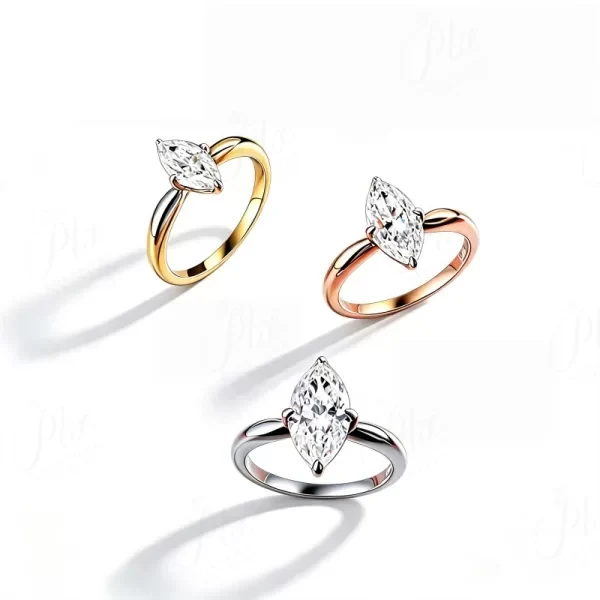
A buyer in Amsterdam sent back a set of matching bands last spring: the engagement ring sat at 2.2 mm shank width, the wedding band we built sat at 2.0 mm, and the two would not sit flush. A 0.2 mm gap sounds small, but on the finger it looks like a manufacturing fault, and the retailer had to remake the pair. The pairing problem is almost never the stone. It is the shank width, the shoulder contour and the metal colour, and we now spec all three on the order sheet before CAD opens.
For the engagement-ring side of the pair, our halo centre-stone guide covers the head proportions. Below is how we match the band to it.
Match the shank width within 0.2 mm
If the engagement ring shank is 2.2 mm wide, the wedding band should be 2.0 to 2.2 mm wide. A band narrower than the engagement shank leaves a step when they sit together; a band wider than the engagement shank crowds the head. We ask the buyer to measure the existing shank at the base, not under the head, because the head side is often thicker. On a new build where we supply both rings, we set both shanks to the same width by default, which is the cleanest way to avoid the gap entirely.
Contour the shoulder where the head dips down
An engagement ring with a low gallery or a halo that drops toward the finger needs a contoured wedding band, with a small notch cut into the band's inner edge so it tucks under the halo. A straight band pushed against a low-set halo never sits flush, and forcing it spreads the prongs over time. We cut the contour to match the exact halo footprint, measured in the CAD. The contour step is the difference between a set that looks made as one piece and a set that looks stacked. For the wide-band profile that suits a contoured pair, our men's band fit and width notes shares the same shank-measurement method.
Match the metal colour exactly, or deliberately contrast it
Mixing rose gold with white gold on a paired set reads as a mistake unless it is intended. We default to the same alloy and colour as the engagement ring, and we batch-cast the pair from the same alloy melt so the tone does not drift between pieces. Where a client wants contrast, we say so on the sheet and build it as a design choice. The alloy purity we stamp follows karat convention, summarised on Wikipedia's karat reference, and we hold the finished alloy inside ISO 9202 tolerances.
Finish and prong style: the last 10 percent
A polished engagement ring next to a matte band looks mismatched. We match the finish, and we match the prong style: a four-prong solitaire pairs best with a clean band that does not introduce new prong language. Where the buyer wants a pave band that shares stones with the engagement ring, we source accent moissanite from the same lot so the white colour does not vary between the two rings. The tennis-bracelet side of matching a set is covered in our custom tennis bracelet build guide.
Should the wedding band be the same width as the engagement ring?
Within 0.2 mm, yes. Exactly the width is cleanest. If the band must be slimmer, we contour the shoulder so the step reads as deliberate.
Can a contoured band be resized?
Yes, but resizing a contoured band re-cuts the notch, so it costs more than resizing a straight band. We size it right the first time using the client's actual finger measurement.
Do the two rings need the same metal?
For a matched set, yes, and we cast from the same alloy melt. Contrast tones are a valid design choice but must be flagged, not accidental.
What if the engagement ring is already bought elsewhere?
Send us the shank width, head height and a side-view photo. We measure the contour from the photo and confirm the fit on the CAD before we cast the band.
The gap that is actually a sizing problem
Not every gap is a contour fault. If one ring sits half a size different from the other, they tilt against each other even when both are the right width. We size a paired set from the same finger measurement and build both rings on the same mandrel size, so the two sit level. A pair that rocks on the mandrel is a sizing mismatch, not a metal mismatch, and we catch it at QC before the parcel ships.
Send us the engagement ring shank width and a side photo. We return the recommended band width and the contour profile on the spec sheet before CAD opens. Ask us to match your next moissanite wedding band flush.
Frequently Asked Questions
Is moissanite a good diamond alternative for retail buyers?
Yes for price-sensitive customers who want brilliance and hardness. Moissanite ranks 9.25 on the Mohs scale, holds up to daily wear and costs a fraction of a natural diamond of the same size, so it resells fast in bridal and fashion lines.
What is the minimum order for wholesale moissanite?
MOQ starts at 50 pieces per design for stock items. Custom cuts and private-label settings usually start at 100–300 pieces depending on the mold.
Do you provide certificates with moissanite stones?
Yes. Every parcel ships with GRA or IGI documentation listing carat weight, color grade and cut. We recommend passing the certificate to your end customer for trust.
How long does sample and bulk production take?
Samples ship in 3–5 days. Bulk runs take 15–20 days under 500 pieces, and 25–30 days for custom work.