Most couples pick an engagement ring first and treat the wedding band as an afterthought. They order something plain to go with it on a whim, slip it on at the altar, and only months later notice that the two rings never really sit together. The band and the ring spend the rest of your married life touching, rubbing and sitting side by side on the same finger, and if they were never meant to meet, you will feel it. A band that floats at a tilt, a ring that spins, or two metals that tarnish at different rates all add up to a set that looks off on day one. The good news is that a matching wedding band is one of the easiest things to plan, as long as you start before the order is placed.
Matching does not mean identical. It means the two pieces were designed to share a finger comfortably. You are not hunting for a copy of your ring; you are hunting for a partner for it. Start with the basics and work outward.
Start with the metal
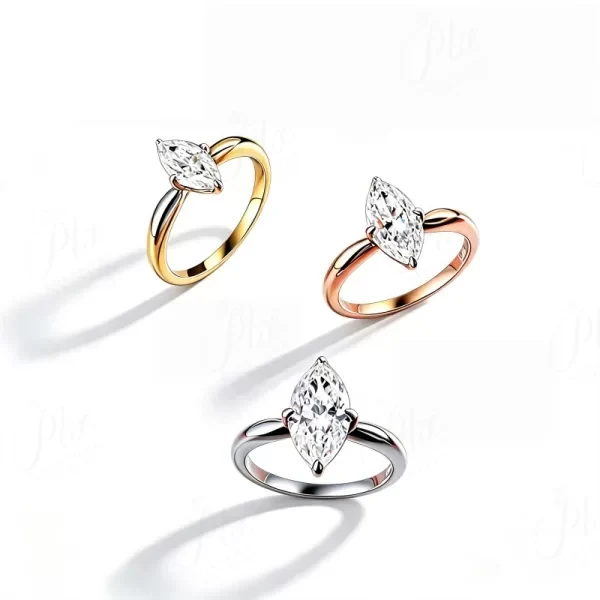
If your engagement ring is set in 925 sterling silver, the simplest and most affordable move is a silver wedding band in the same finish. Rhodium-plated silver takes a bright, mirror polish that echoes a solitaire and reads almost like white gold at a fraction of the price. Unplated matte silver pairs better with vintage or art-deco settings, where a soft brushed finish feels deliberate rather than cheap. Mixing silver with gold is a deliberate fashion choice, and it is very much on trend for modern bridal looks, but on a traditional wedding set it often reads as unfinished unless you own the mismatch on purpose.
Because sterling silver is softer than platinum or 14k gold, a silver band will show wear faster, and it will tarnish if ignored. That is fine for a ring you adore and plan to care for, but it tells you to keep both pieces out of harsh chemicals and to store them separately when you sleep. See our guide on caring for silver jewelry so the set stays bright for years rather than darkening within a season.
Match the profile, not just the width
The profile is the cross-section of the band, and it decides how flush the two rings sit. A flat comfort-fit band, with the inside rounded and the outside flat, nests neatly against most solitaire settings. A high-domed euro-shank band, curved on the outside, will not sit flat against a halo or a raised setting, and it will leave a visible wedge of air between the two. When you order, ask the maker whether the band can be shaped to curve around your setting, or whether a straight band is your only option.
A contoured or notched band is the professional move for rings with a high setting or a halo. It has a small curve cut into the edge that wraps around the basket of the engagement ring, eliminating the wobble and the gap. If your center stone is a moissanite solitaire in silver, a slim 2 to 3 mm contoured band keeps the focus on the stone rather than on bulk, and it slides right up against the setting without catching on the prongs.
Width and proportion
Thin engagement rings want thin bands. A 1.5 mm solitaire will disappear under a 6 mm men's-style band, and the delicate look you chose will be overwhelmed. As a rule, keep the wedding band within about 1 mm of the engagement ring's shank width. If you want a statement set, choose the wider band first and scale the engagement ring to it rather than the other way around. Thicker hands and larger knuckles also carry wider bands more gracefully, while slender fingers read best with slim, stacked pieces.
For couples who want his-and-hers sets, a shared profile and finish look cohesive even when the widths differ. A 4 mm matte men's band and a 2 mm matching women's band read as one family. Our piece on men's silver wedding bands covers that side of the pair, so you can choose both rings with the same visual language in mind.
When to add an enhancer
An enhancer, a curved U-shaped band designed to cup the engagement ring, is the fastest way to lock a loose ring in place and create a closed, bridal look. It works beautifully with low-profile solitaires but can crowd a halo or a large center stone, so try the ring on over a cushion or round setting before you commit. Enhancers also make a wonderful anniversary upgrade, turning a single solitaire into a three-piece stack without redoing the original ring or resetting the stone.
Avoid these common mistakes
The first mistake is ordering the band without the ring present, which means guessing at the gap and the setting height. If you buy online, send the engagement ring's measurements, including shank width, setting height and stone diameter, to the jeweler before production begins. The second mistake is skipping the resizing step: a band that fits on its own finger may feel tight once the engagement ring is added beside it, because the two rings together take up more room. Always size the finger with both rings on. Finally, do not wait until the last month to order. Contoured and shaped bands often take longer than plain ones, and you do not want to rush a keepsake.
The payoff of planning this way is a set that looks like it was born together. You wear two rings, but they should read as one piece, and when they do, every glance down at your hand feels exactly right.
Sterling silver terminology used in this guide follows the Wikipedia entry on sterling silver.
Frequently Asked Questions
What ring sizes can you supply in bulk?
US sizes 5–12 including half sizes. Send a size breakdown with your order and we cast to that curve; comfort-fit inner bands reduce resize requests.
Can I order a mixed size run instead of one size?
Yes. Mixed runs are standard for wholesale: specify quantity per size and we pack and label by size at no extra labor cost.
What is the MOQ for custom ring designs?
50 pieces per design for existing molds; 100–300 pieces when a new mold or CAD model is required.
How should I price rings for retail margin?
Most partners use a 3–4x markup on FOB cost for sterling and 2.5–3x for moissanite solos, which keeps landed cost under 30% of retail.