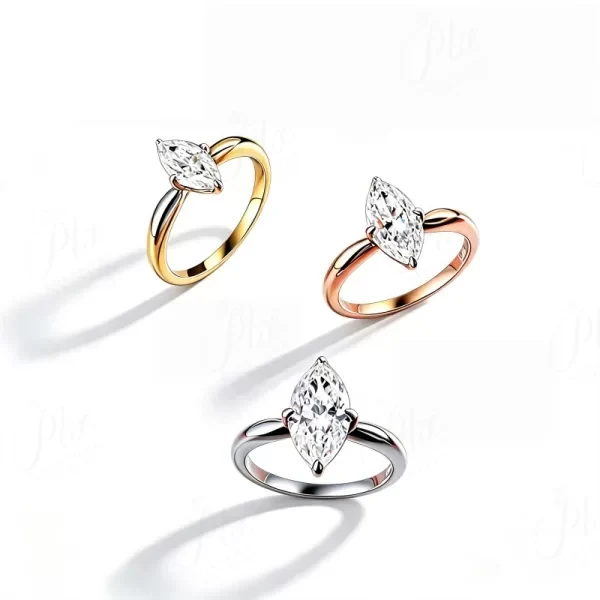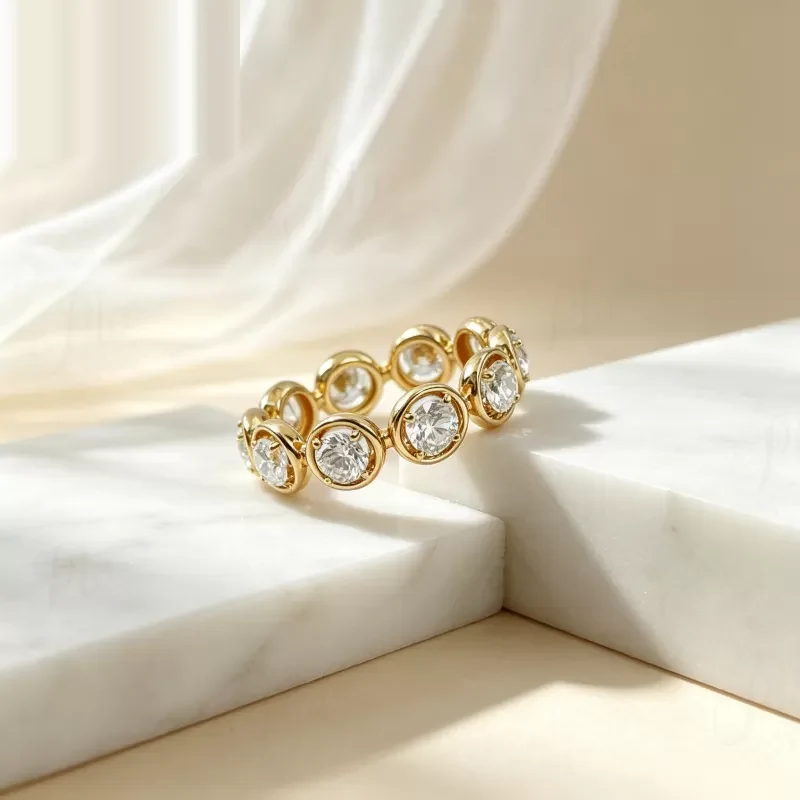
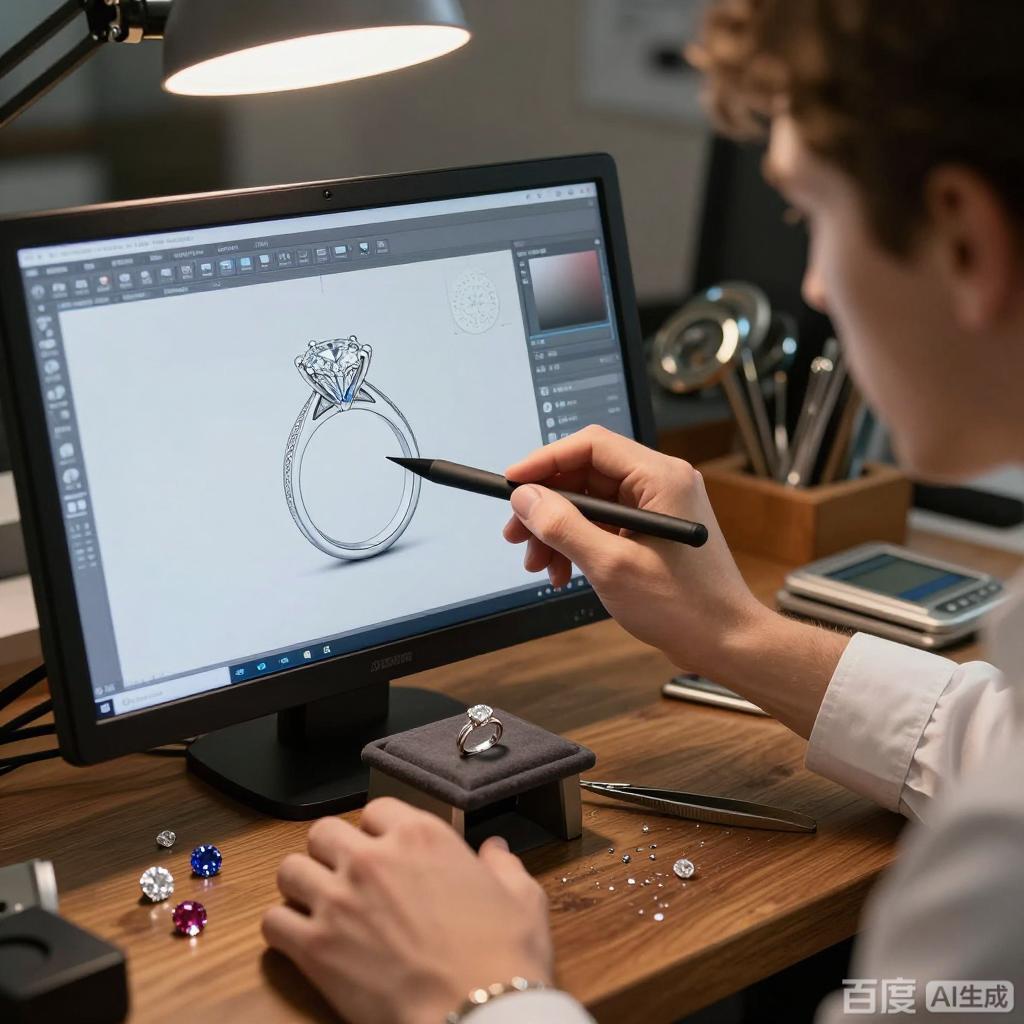
A Canadian bridal brand approached us in early 2025 with a specific vision: an east-west oval moissanite engagement ring with a knife-edge band, bezel setting, and a single diamond accent set flush into the shank. Their client wanted something that felt modern and architectural—not the standard solitaire or halo. They had been quoted $450 per ring by a US-based custom jeweler, which put it out of their $800 retail price point when factoring in their margins. We engineered the design, produced three CAD iterations, made a silver prototype, adjusted the bezel thickness after the client found it too bulky in hand, and delivered 80 pieces in 14K white gold at $138 per unit within 8 weeks. The ring launched at $795 retail and sold out in 18 days.
Custom moissanite engagement rings represent the highest-margin product category for bridal brands, but they also carry the highest risk of production issues. Engagement rings are the most emotionally significant piece of jewelry a person will ever buy, and custom versions carry expectations that stock rings do not. Customers wait months for them, they pay premium prices, and they notice every detail. This guide walks through what goes into custom engagement ring manufacturing, how to specify designs that factories can actually produce, and how to avoid the mistakes that lead to late deliveries, returns, and unhappy couples.
Key Design Decisions in Custom Engagement Rings
Every custom engagement ring involves dozens of engineering decisions that affect appearance, durability, comfort, and cost. These are the decisions brands most often get wrong when specifying custom designs:
- Center stone cut and orientation: Round brilliant is the easiest to set and the most forgiving. Oval, pear, marquise, cushion, emerald, and radiant cuts each require different setting approaches. East-west orientation (stone set across the finger rather than along it) changes the entire structure and requires wider, flatter prongs or a custom bezel. Asymmetrical cuts (pear, marquise) need careful weight distribution to avoid spinning on the finger.
- Setting type: Prong settings (4-prong, 6-prong, compass prongs, double prongs) show more stone but require precise prong geometry. Bezel settings are the most secure but add metal around the stone that some customers find visually heavy. Halo settings (single, double, hidden, floating) require 0.3-0.5mm melee stones set with exact spacing. Tension and semi-tension settings require specific metal hardness and careful engineering.
- Band profile: Knife-edge bands look sleek but can feel sharp and uncomfortable in wider widths. Comfort-fit bands (rounded interior) feel better but slightly raise the ring. Domed bands are classic but show more metal. Flat bands look modern but can catch on things. Band widths below 1.8mm risk bending with daily wear; bands over 4mm look bulky on smaller finger sizes.
- Shank design: Split shanks, twisted shanks, bypass designs, and tapered shanks all change the structural integrity. Twisted shanks below 2mm thickness are prone to bending at the twist point. Split shanks require reinforcement where they join the head.
- Accent stones: Side stones, pavé, channel set, or flush set accents add complexity. Pavé-set melee below 1.3mm has higher stone loss risk in daily wear and requires secure U-notch or V-prong settings. Channel settings must have exact groove depth or stones will fall out or crack during setting.
- Metal choice: 14K white gold is the bridal standard (harder than 18K, holds prongs better). Platinum is denser, heavier, and more durable but 2-3x more expensive in material cost. 925 silver is budget-friendly but requires rhodium plating to look white and is too soft for secure prong settings on larger stones. Rose gold uses copper alloy which can cause skin reactions in some wearers.
GIA cut grade standards apply to custom-set moissanite center stones just as they do to diamonds: the proportions of the cut determine brightness and fire. When specifying custom rings, tell us the center stone shape, size (mm dimensions, not just carat weight), and preferred color grade. Browse our moissanite engagement ring design gallery for reference, and explore our OEM custom programs for brand-specific development.
Custom Engagement Ring Style Comparison
Different custom ring styles carry different manufacturing costs, lead times, and durability profiles:
| Ring Style | Custom Unit Price (14K, 1ct center, 50pc) | Lead Time | Durability | Design Complexity | Best For |
|---|---|---|---|---|---|
| Custom solitaire (simple prongs) | $105-$135 | 7-8 weeks | Excellent | Low | Everyday wear, classic brands |
| Custom halo ring | $130-$175 | 8-9 weeks | Good | Medium | Brilliant sparkle, bridal |
| Hidden halo ring | $140-$185 | 8-9 weeks | Good | Medium | Clean profile with secret detail |
| Three-stone ring | $145-$195 | 8-10 weeks | Good | Medium-High | Symbolic designs, heirloom look |
| Pavé band ring | $135-$180 | 8-10 weeks | Fair (stone loss risk) | High | Maximum sparkle, special occasion |
| Split shank ring | $150-$200 | 9-10 weeks | Good (reinforced shank needed) | High | Statement look, larger fingers |
| Vintage/filigree ring | $170-$240 | 9-12 weeks | Fair (delicate details) | Very High | Artisan brands, vintage aesthetic |
| Bezel set modern ring | $125-$160 | 7-9 weeks | Excellent | Medium | Active wearers, modern brands |
| East-west fancy cut | $140-$190 | 8-10 weeks | Good | High | Trendy, Instagram-driven brands |
| Two-tone / mixed metal | $170-$230 | 9-11 weeks | Good | Very High | Designer brands, unique looks |
Prices are indicative for 50-piece runs with D/VVS1 round or oval moissanite center. Fancy cuts (cushion, emerald, pear, marquise, heart, trillion, hexagon) add 5-15% depending on availability. Platinum adds approximately 80% to metal cost. Sterling silver versions of the same designs typically run 40-50% of 14K gold pricing. We always provide specific pricing after reviewing your design brief. The FTC Jewelry Guides require accurate disclosure of metal content and gemstone type—our compliance team ensures all custom pieces meet FTC marking requirements before shipment.
Common Custom Ring Manufacturing Mistakes to Avoid
After producing 400+ custom engagement ring designs, these are the mistakes we see brands make repeatedly:
Specifying stone size by carat weight without dimensions. A 1ct oval moissanite from one supplier might measure 7x5mm; another brand's 1ct oval might be 8x6mm. The difference changes the head size, prong positions, and overall proportions of the ring. Always specify center stones by mm dimensions when ordering custom designs, or approve CAD renders with actual stone measurements before prototyping.
Designing bands too thin. Bands under 1.8mm in 14K gold bend under normal wear—especially at stress points like the base of prongs or where a split shank joins. The ring looks delicate and elegant in renders, but customers report bent bands within months of daily wear. Our minimum recommended band thickness for daily-wear engagement rings is 2.0mm at the thinnest point. If you want a thin look, consider a tapered band that thickens at stress points rather than a uniformly thin shank.
Setting stones too high. High-set center stones look dramatic in photos but catch on gloves, sweaters, hair, and pockets. High settings also put more leverage on prongs, increasing the risk of bent prongs and lost stones. For everyday wear rings, we recommend setting the center stone table no more than 7-8mm above the finger. Low-profile designs set the stone 5-6mm high and are far more practical.
Overcomplicating the first custom design. Brands often want their first custom ring to have everything: hidden halo, pavé band, colored accent stones, twisted shank, engraving. Each additional feature adds complexity, production risk, and potential failure points. Start with a cleaner design for your first custom piece and add complexity in future iterations once you know how the design wears.
Not testing the prototype on multiple finger sizes. A ring that looks perfect on a size 6 finger can feel completely different on a size 4 or size 9. Band width that feels substantial on a small finger looks delicate on a larger one. When we produce prototypes, we make them in the target customer's most common size (typically US 6-7), but we recommend testing wearability across at least two sizes during the evaluation phase.
Stone Options for Custom Engagement Rings
Moissanite is the core of most custom bridal programs we produce, but many brands incorporate additional stones:
- Moissanite center stones: Available in D/E/F colorless, G/H near-colorless, and fancy colors (champagne, gray, black, green, blue). Cuts include round brilliant, oval, cushion, emerald, radiant, pear, marquise, heart, asscher, princess, trillion, hexagon, old European cut, rose cut, and custom freeform shapes. Sizes from 1mm melee up to 15mm+ (approximately 10ct equivalent).
- Moissanite melee: Sizes 0.8mm to 3mm for halos, pavé, and accents. Faceted to the same standards as center stones for consistent sparkle and color matching across the piece.
- Lab-grown diamonds: Available as center stones (more expensive than moissanite, lower margin but demanded by some customers) and melee. Available in D-F color, VS-SI clarity.
- Natural colored gemstones: Sapphires (blue, pink, yellow, white, teal), rubies, emeralds, morganite, aquamarine, amethyst, and topaz can all be incorporated as accents or center stones. Softer stones (opals, pearls, turquoise) are not recommended for everyday engagement rings due to durability.
- Synthetic colored stones: Cubic zirconia, nano gems, and synthetic corundum provide colored stone looks at lower cost but do not carry the same value or durability as natural or lab-grown colored stones.
We recommend matching the accent stones to the center stone hardness. Moissanite is 9.25 on the Mohs scale; diamond is 10. If you set moissanite accents next to a diamond center, over time the harder diamond can abrade the moissanite. For mixed-stone designs, we recommend lab diamond accents with moissanite centers for consistent long-term wear, or moissanite accents with moissanite centers. Our gemology team can advise on specific stone combinations during the design phase.
Custom Ring Quality Control Checks
Custom designs go through all our standard QC checks plus additional tests specific to their features:
- Prong integrity test: Each prong is tested with a calibrated force gauge to ensure it can withstand 5lbs of lateral pull without bending or loosening. This is the single most important test for engagement rings—prong failure means a lost center stone.
- Stone seating verification: Every center stone is checked under 20x magnification to ensure full contact with the seat, no gaps, and no metal over the stone table that would dull sparkle.
- Shank strength test: Ring shanks are tested for flex resistance by applying controlled pressure at the bottom of the band. Thin or weak shanks flex more than 0.5mm are rejected and re-cast with thicker walls.
- Melee security check: Every pavé and accent stone is individually poked with a fine probe under 10x magnification to detect any loose stones before shipment.
- Ring size verification: Every ring is measured on a ring mandrel to ensure it matches the ordered size within ±0.25 US sizes. Custom rings are checked against the approved prototype for dimension consistency.
- Finish consistency: Polishing is checked at all angles under bright light. Any file marks, casting porosity, or uneven plating is returned to finishing. Matte, brushed, sandblasted, and hammered finishes are compared against a finish sample for consistency.
- Hallmark and stamping: Metal purity mark (14K, 18K, 925, PT950) and brand stamp are verified on every piece per FTC requirements.
Our custom ring defect rate runs under 0.8% across thousands of pieces produced, and every piece is backed by our 12-month manufacturing defect warranty. View our quality control process for complete details on inspection procedures.
Frequently Asked Questions
Q: Can you replicate an existing ring design?
A: We can use existing rings as reference inspiration and produce pieces with similar elements, but we cannot produce exact copies of branded designs protected by design patents or copyright (Tiffany settings, Cartier designs, etc.). We can create designs inspired by aesthetics you like while ensuring the final piece is sufficiently original to avoid IP issues. Provide reference images and describe what you like about them (profile height, prong shape, band profile) and we will design something in that spirit.
Q: What is the minimum order quantity for custom engagement rings?
A: 50 pieces per custom design. One-off samples are available at sample pricing ($200-$400 depending on metal and stone size) before you commit to bulk production. Small batch runs of 20 pieces are available at 20% premium for brands testing a new design. Reorders of existing custom designs start at 30 pieces.
Q: Can you make custom rings in multiple metals?
A: Yes. The same CAD design can usually be produced in 14K white/yellow/rose gold, 18K, 925 silver, and platinum without modification. Different metals have different casting shrinkage rates, so we adjust molds slightly for each metal. Metal type must be specified before production starts because it affects polishing approach and rhodium plating (white gold and silver require rhodium; yellow/rose gold and platinum do not).
Q: How do custom rings ship and package?
A: Each ring is individually wrapped in anti-tarnish tissue, placed in a padded ring box, and packed in protective outer cartons. We support fully custom packaging (branded boxes, pouches, cards, care instructions) for orders over 200 pieces at additional cost. All shipments use FedEx or DHL with insured, trackable shipping.
Q: What if customers request ring sizing after purchase?
A: Most custom rings can be resized ±2 US sizes without structural issues, depending on design. Full eternity bands, tension settings, and rings with continuous pavé cannot be resized easily. We provide detailed resizing guidelines for each custom design we produce. We also recommend producing each design in sizes 4-9 (with half sizes) for bridal to minimize sizing issues.
Q: Do you offer engraving or personalization on custom rings?
A: Yes. Inside-band engraving (dates, names, short messages) is available at $3-5 per ring depending on length. Hand engraving on the outside of the band adds $15-25 per ring. Laser engraving for fine details or logos is available at $2-4 per ring. Engraving is done after final polishing and before final inspection.
Key Takeaways for Custom Engagement Rings
Custom moissanite engagement rings are the highest-margin category in bridal jewelry, but they require careful specification and a capable manufacturing partner:
- Specify center stones by mm dimensions, not just carat weight
- Keep band thickness at 2.0mm minimum at stress points for everyday durability
- Set center stones at 5-8mm height for balance of appearance and practicality
- Start with cleaner designs for your first custom piece; add complexity later
- Budget 8-10 weeks from design approval to delivered bulk order
- Test prototypes on multiple finger sizes before approving bulk production
- Match accent stone hardness to center stone hardness for long-term wear
- Expect specific QC checks tailored to your design's unique features
If you have a custom moissanite engagement ring concept—whether a detailed sketch, a reference board, or just an aesthetic direction—send it to our design team for a free feasibility review. We will assess manufacturability, provide ballpark pricing, suggest any engineering adjustments needed, and outline a timeline. There is no cost or obligation for the initial design consultation. Custom engagement rings are where brands build loyalty and identity; let us help you turn your vision into pieces that couples will wear for decades. Start your custom ring project today.